
 |
 |
« The body is humanity’s primary territory. »
Frantz Fanon. (psychiatrist and philosopher from Martinique, 20th century) |
The human body,
a model of democracy
and international relations.
Preamble :
1 - The pursuit of happiness :
2 - Cancer :
A – The biological functioning of cell :
B - How, then, can we understand the onset of cancer ?
a – The origin :
b – The causes :
c – The progression :
d – The body’s control over cells :
e – The subversion of this control :
f - The influence of behaviour on the fate of cells :
g - hat, then, can be done ?
c – The solutions :
C – From the cell within the body to the individual within humanity :
a – The origin :
b – The causes :
c – Society’s influence on the individual :
d - Misdirected control :
e - How do antisocial behaviours develop ?
f - What can be done, then ?

Preamble :
The analysis that follows draws on analogical reasoning and does not claim to be based on scientifically proven facts. It is a simple hypothesis designed to shed light on certain aspects of human behaviour that could be improved by drawing inspiration from the natural tendencies of Evolution to organise life
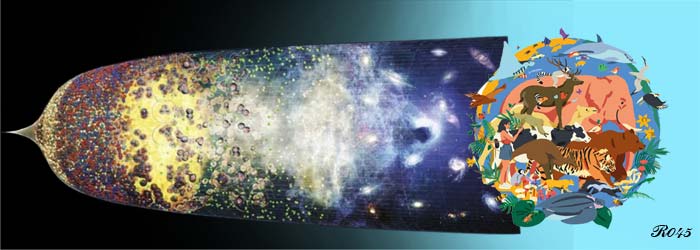
We have observed, in fact, that human beings, from childhood onwards, rely on the reality of facts before allowing themselves to be influenced by social certainties [see : The natural abilities of the child].
Furthermore, we have come to understand that all biological processes, when working in the service of life, take account first and foremost of environmental reality through sensory perception.
Having therefore observed that all the elements of the organism work together, whilst respecting one another, to resolve all situations, we shall now attempt to answer certain questions which have very often yielded surprising, if not entirely logical, answers.
- Internally : cohesion and consistency of behaviour,
- At the body’s boundaries : sensory perception,
- With the environment : interrelationships, sharing and solidarity.
As these are hypotheses, all the pages that follow will be preceded by the note :
1 - The pursuit of happiness :
We wonder why the world is in such a sorry state.Yet we are surrounded by examples that should enable us to improve ourselves. These examples fall into two categories: the good ones, which we should emulate, and the bad ones, which we should avoid.
Whilst we observe, day after day, human beings turning the world they have come to dominate upside down, let us try to understand how the world of cells works to bring about the creation of every human being’s life.
As for humans, it is easy to grasp their approach to life : they love happiness, yet complain of not finding it ; they say they hate war and the suffering it causes, yet they cannot do without conflict.
Whilst animals fight for the territory that ensures their survival, or to protect their young, humans fight against their own species, and against all others. A single man can send thousands of men to their deaths for a territory he does not need, sometimes in the name of a fallen empire or in the name of a god of war who is said to have granted him that territory. He may also act in this way for his own sake.
But above all, human beings love money and power, which, however, never satisfy them.
Does he ask himself the right questions ?
Is he, then, incapable of drawing inspiration from the examples that life presents to him at every moment ?
First and foremost, humans claim to be in search of happiness.
Physiologically speaking, how do we experience it ?
AI, which is incapable of experiencing it, nevertheless tells us « When we are happy, we feel a sense of lightness, calm, serenity, fulfilment and well-being ».
baby shows us happiness through the joy it experiences in interacting with its surroundings. To do this, it needs only one thing: to feel. It is even capable, without the aid of speech, of making us feel its happiness.

To be happy, then, is to feel a sense of well-being and joy. This has nothing to do with meditation when it involves isolating oneself from a living environment in an attempt to experience one’s senses in the silence of a carefully chosen setting.

Why this inability to find happiness or, quite simply, to feel it ?
The best way to do this is to understand one’s own body and follow its example.
Our body is made up of around 37,200 billion cells (3.72 × 10¹³ in scientific notation). How does it experience well-being? Why does it experience it?
Because an incredible number of cells, each one different from the next, function in harmony, without any conflict that causes suffering or discomfort… 37,200 billion cells working together.
For example, what do they do to feed us ?
The cells in the hands gather food,
The muscle cells in the upper limbs carry it to the mouth,
The cells in the mouth take in the food and chew it,
Those in the stomach secrete acid and those in the muscular wall break it down into a pulp.
The cells of the intestine sort out the nutrients, absorb them and release them into the blood.
The heart, via the blood, redistributes the nutrients throughout the body.
Waste ends up in the rectum, which stores it until it is expelled.
Does a single cell in our body appropriate the wealth of several billion of its fellow cells, as happens in humans ? What would happen if that were the case ?
Fortunately, in our bodies, this is not the case.
Brain cells take what they need, just like those in the rectum. None takes more than it needs ; the only thing that sets them apart is their differing energy requirements.
Both ‘know’ that they cannot do without one another. Their survival is closely dependent on the organism that, together, they help to sustain.
Although they are not equal in function, they are equal in importance.
The brain would die without its ‘scavengers’, and the rectum would follow the brain in death.
but each works for the whole community of cells in the body. »
We humans, who consider ourselves to be very intelligent, believe that brain cells are more intelligent than cells in the rectum and that, similarly, politicians or financiers deserve more than refuse collectors. Is such a judgement justified ?
Do the cells that make up sponges, then, possess a form of ‘knowledge’ that humans lack ? Let us remember that, right from the start of evolution, they ‘understood’ that they would benefit by pooling their abilities, without exploiting one another.
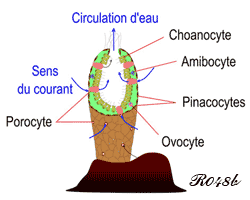
Moreover, if we set aside the notion of intelligence as the driving force behind evolution, we see that even the particles of matter at the very beginning come together (in french) to increase in size and acquire multiple functions.
Thus, each possesses its own function and identity, just as every human being possesses a ‘gift’ that is different from and complementary to that of all their fellow human beings. This function is fulfilled with ease when this innate ‘gift’ is freely utilised; it is fulfilled with difficulty when the ‘gift’ is abandoned in order to conform to collective norms.
As we have seen, for the labourer or refuse collector with the appropriate physical build, physical labour is easier than for the engineer, who is more ‘muscular’ in intellectual terms; but the engineer, whose ability lies in putting his grey matter to work, should not feel a sense of superiority: he simply possesses a natural aptitude in his field.
This is how the engineer or architect is able to design an object or a skyscraper that only the manual worker can build. Nothing can come about without both of them
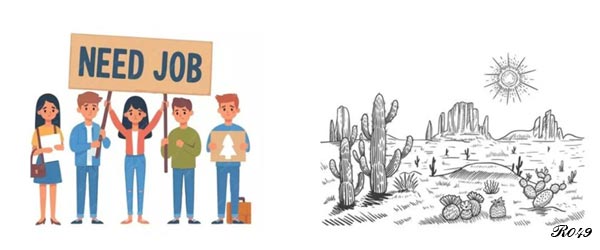
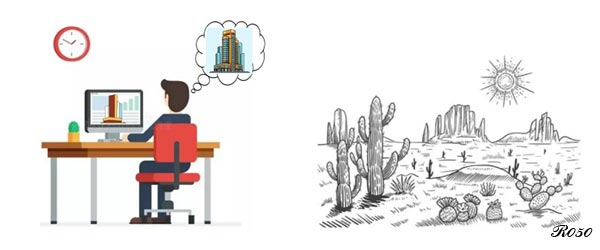
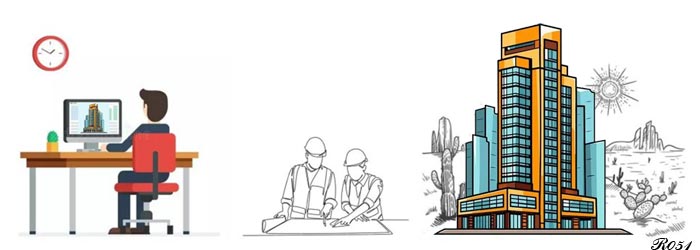
We might also mention the importance of the farmer or the police officer, who do not count their hours when it comes to feeding or protecting others. For each of them, every hour of work represents the same collective effort. Why such disparities in pay or wealth, which lead only to the waste of resources, something an organism built to survive could never afford ?
What a difference « Sapiens » hunting to survive, and « Insensatus » the smooth-talker, oblivious to the world in which he lives !
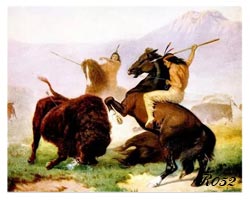
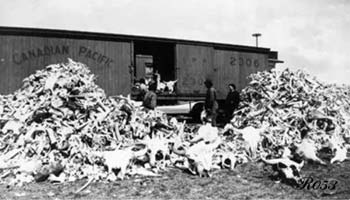
It is in this way that, thanks to their solidarity and complementary functions, all the cells build our body and keep it alive; these cells are so intelligent that humankind seems quite incapable of matching them.
In the human body, and in that of any other living being, this perfect collaboration is known as « good health ». Conversely, malfunctions in this solidarity manifest themselves as what we cal « illness ».
« Homo Insensatus » is well acquainted with these malfunctions, which he induces at will within the international « human organism ». This organism comprises billions of different and complementary human beings, millions of territories with complementary resources, and… thousands of kilometres of walls designed to steal or protect resources that existed solely to be shared.
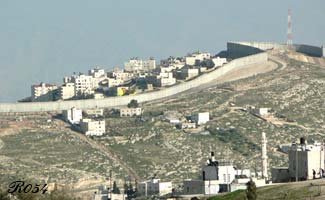
Homo’s narcissistic brain cells lead him to imagine himself as perfect; this is why he can claim all the credit and all the wealth for himself.
If the assets are financial, this condition is called corruption; on a physical level, this condition could be compared to an addiction to the pleasure derived from sugar or alcohol, resulting in obesity or diabètes.
If these traits are territorial in nature, this pathology is called dictatorship: it could then be likened to a brain injury causing a loss of sensitivity, with an inability to feel the suffering inflicted on one’s fellow human beings, or to a cancer that invades and takes over large parts of the body.
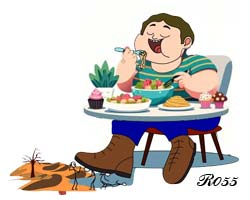
This is how, in the human world, a multitude of disorders can arise. In the individual, conflicts create stress; stress generates an inner conflict which may manifest as a physical illness or be channelled into violence.
But whether internal or external, violence is always destructive.
Let us therefore examine two types of cellular processes that closely resemble human functioning : one pathological—cancer—and the other physiological—the presence of the gut microbiota.
2 - Cancer :
Cancer arises in an already established organism. If the original cell had in fact been cancerous, the subsequent cells would immediately have formed a mass of cells incapable of differentiating and would have been expelled by the host organism.To understand the mechanisms by which cancer arises, we must therefore begin by understanding the conditions that determine the development of the body’s cells, leading to a healthy adult human being.
A - biological functioning of cells :
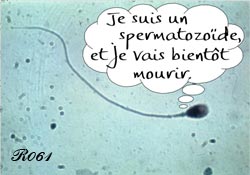
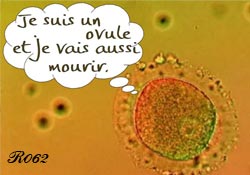
The first cell, from which a human being will develop, results from the fertilisation of an egg by a sperm cell – two complementary cells, each of which contributes its own DNA. The fusion of these two parental cells, each with different characteristics, will provide two complementary ways of integrating into the living world.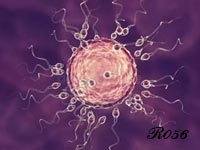
During the period when the resulting cell simply divides, its proliferation is no different from that of a cancer cell.
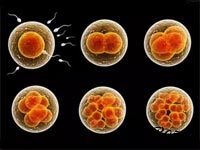
It is a few days later, at the blastula stage, that things change: the cells continue to multiply, but according to a specific plan. They arrange themselves to form a hollow sphere.
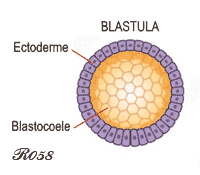
Then, after the embryo has implanted in the uterine wall, between the 6th and 10th day, gastrulation begins: between the 2nd and 4th week, the cells organise themselves into three distinct layers – the ectoderm, mesoderm and endoderm – marking the first differentiation of the cells.
The cavity they enclose opens outwards via the blastopore, which will later become the digestive system.
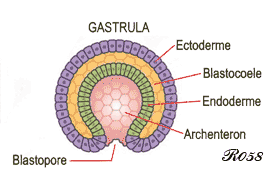
These layers contain the stem cells that will give rise to tissues and organs between the 4th and 10th weeks. This is when the first organs (heart, nervous system, etc.) begin to form. By the 8th week, the embryo becomes a foetus.
We can thus see that, before going on to populate the world with living beings, all of which are different, the cells – initially undifferentiated – began to group together in colonies and communicate with one another in order to work towards a common goal.
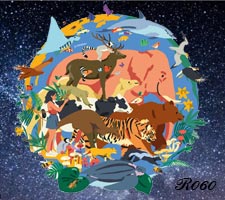
To achieve such a feat, they had to ‘learn’ that their autonomy is relative, learn a specialised function (respiration, circulation, digestion…), learn that they belong to an organ, and learn that they belong to a living organism capable of cooperating with other organisms.
 |
 |
« I am a sperm cell, and I am going to die soon ». |
« I am an egg, and I too will die ». |
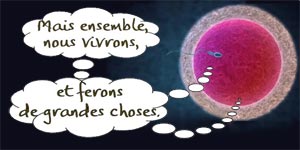
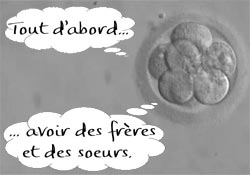
« First of all, having brothers and sisters ».
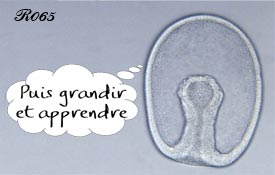
« Then grow up and learn ».
 |
 |
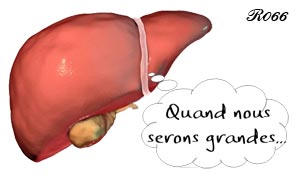
« When we grow up,... » |
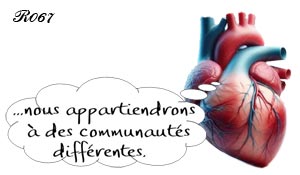
« ...we’ll belong to different communities ». |
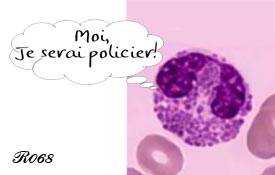
« As for me, I’m going to be a police officer ».
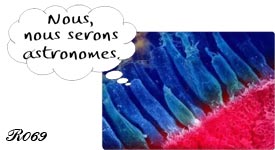
« We, we’ll be astronomers ».
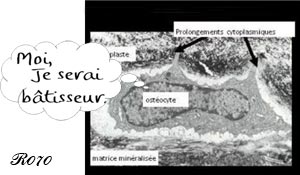
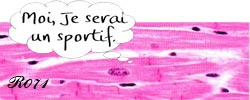
« As for me, I’ll be a sportsman ».
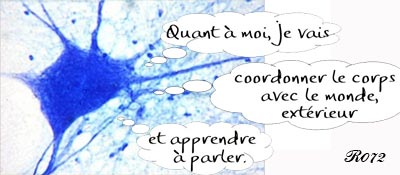
« As for me, I’m going to coordinate the body with the outside world,
and I’m going to learn to speak ».
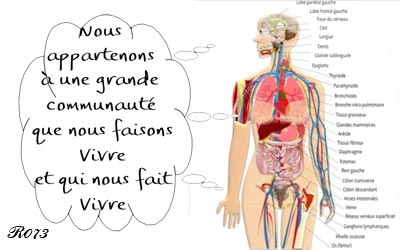
« We are part of a large community
that we help to sustain,
and which sustains us ».
We can therefore see that :
proves capable of creating life, health and the well-being of a human being. »
B – How, then, can we understand the development of cancer ?
The term « cancer » refers to a wide range of diseases that differ greatly from one another depending on the organ affected. These diseases most often require treatments that leave cancer cells with no chance of survival. However, these cancer cells are not solely to blame: other factors play a part in their development.We shall therefore focus on the general functioning of cancer cells within the body.
We can then attempt to draw a parallel between this cellular dysfunction and certain human behaviours.
a – The origin :
The first cells in the human body result from the fusion of two parent cells that are, in principle, normal; otherwise they could not form a viable foetus.
It is only once the body is fully formed that a malfunction may occur in one or more so-called cancerous cells, which then begin to divide and proliferate at a rapid rate.
Unable to differentiate, they remain young and immature cells.
Furthermore, each cell contains DNA, which serves both as the cell’s « identity card » and as the framework governing the functioning of the entire organism.
However, this DNA is not static : certain genes move (in french) along the DNA strand [see : epigenetics], causing it to evolve in response to information received from the external environment.
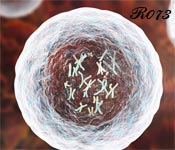
within the cellular community.
b – The causes :
The causes of cancer are highly varied.
They include genetic and environmental factors (pollution or UV radiation), as well as chronic inflammation. They also include lifestyle factors (smoking, alcohol, an unbalanced diet). However, if we exclude genetic causes, we find that the factors leading to the onset of cancer are essentially environmental.
Pollution, radiation, chronic inflammation and lifestyle habits are primarily harmful over the long term, as they trigger DNA repair or the replacement of diseased cells. As cells divide, and despite these repairs, DNA mutations accumulate and contribute to the development of cancer.
c – Neoplasia :
This word derives from the Greek "neos" (new) et "plasis" (formation), literally meaning "new formation". When used in a medical context, this term provides an initial insight into the characteristics of the invading cells.
It refers to the emergence of young cells, distinct from the others, whose behaviour deviates from the body’s pre-established programme of development and function.
As they divide, they proliferate in an uncontrolled manner.
This proliferation, initially localised, spreads to the surrounding tissue. These abnormal cells then metastasise throughout the body.
d – The body’s control over cells :
Throughout our lives, our bodies develop and function thanks to the division and renewal of our cells. Every day, some cells die and others are born. As for DNA, it undergoes mutations linked either to bodily malfunctions or to toxins. However, we have defences : the immune system, the correction of DNA abnormalities, and apoptosis which is described as programmed cell death. This latter mechanism is present in the foetus : the interdigital cells die to allow the fingers to form. The cell’s programme also provides for its self-destruction when it is too old or has suffered irreparable damage to its DNA.
e – Circumventing the rules :
However, cancer cells evade this natural regulation by the body. They ignore the collective rules and, as they multiply, they spread into the territory of healthy cells. In doing so, they draw their energy from the nutrients available in the body, particularly glucose.
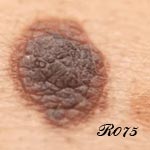
Furthermore, as these are the body’s own cells, the immune system usually remains inactive. They therefore evade the body’s defence mechanisms and continue to accumulate mutations.
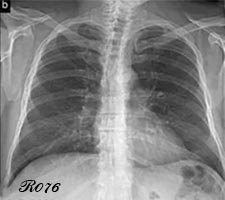
As they proliferate rapidly, they initially remain clustered together, forming a tumour that gradually invades an organ and renders it unable to function properly.
 |
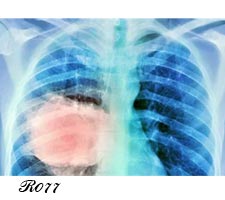 |
Healthy lungs. |
Invasion of a part of the body. |
Subsequently, the cancer cells will migrate to other organs, which they will colonise. This is known as metastasis..
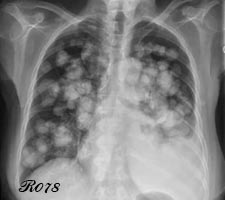
f - The influence of an individual’s behaviour on the fate of their cells :
Neglect plays a major role in the development of cancers. Whilst they become more common with age due to the gradual weakening of our protective and repair mechanisms, the occurrence of mutations increases considerably, particularly »when our cells are subjected to toxic behaviours over the long term : smoking, alcohol consumption, poor diet or lack of physical activity.
Ultimately, a single cancer cell can, once it has multiplied, « appropriate » all the body’s resources and lead to death.
g - So what can we do ?
In the case of cancer, it is not possible to directly influence certain factors, such as ageing or heredity. The body itself seems powerless in the face of these harmful cells, which are, however, part of the body.
On the other hand, it is possible to change our behaviour. It is widely accepted that nearly half of all cancers could be prevented if we changed our habits: adopting a healthy and varied diet, taking up physical activity, and giving up smoking or alcohol.
Once cancer has been diagnosed, les spontaneous recoveries are rare, but a drastic lifestyle change can sometimes lead to remission, resulting in a longer life expectancy.
What does medicine offer when it fails to reintegrate rogue cells into the body’s overall functioning? To date, the approaches have primarily been aggressive, either through eradication (surgical or using toxic molecules) or by stimulating the immune system using infectious agents (BCG).
C – From the cell within the body to the individual within humanity :
We now know enough to draw a parallel between cellular behaviour within the body and certain human behaviours that inevitably lead to conflict and destruction.Deviant behaviours in human societies vary greatly from one another. However, apart from ideologies embedded in culture, certain harmful behaviours are recurrent: theft, violence, lying…
The causes of these behaviours are twofold: pathological or environmental. As pathological causes fall solely within the realm of medicine, we shall not consider them here.
Having therefore considered the child’s innate capacities and, in particular, their moral sense , we shall assume here that these aberrant behaviours stem from an external influence that has redirected the child’s natural tendencies.
a – The origin :
Just as the original cell arises from two parental cells, the newborn is the product of two parents with complementary characteristics.
The child therefore has access to several possible behaviours at his disposal : those of their father, those of their mother, or a combination of the two. Through interaction with their parents, they gradually learn to distinguish between the advantages and disadvantages of the abilities they have inherited.
b – The causes :
Thanks to these abilities, the child should flourish by choosing the best solutions when difficulties arise. However, this is not always the case.
What factors might lead to disturbances in a child or adolescent ?
Having ruled out any proven medical condition, we can consider the possibility of an inadequate or harmful environment, such as shortcomings in parenting and schooling : the contribution of the wider community to individual well-being has not been sufficiently explained. Similarly, the social constraints that require respect for others to take precedence over one’s own impulses have not been understood. Society is therefore rejected.
Furthermore, it is clear to everyone that a child speaks the language they have heard their parents speak.
In the same way, they will replicate the behaviours they observe : those of their parents will be crucial; later on, the most widespread social behaviours will be regarded as the norm to be followed. This may include violence and numerous antisocial behaviours.
From birth, therefore, the child possesses the essential capacities to integrate into the world through their senses, and into the community through their innate intelligence. However, in the human world, they must very often set aside their own knowledge to prioritise the language and rules of their group.
 |
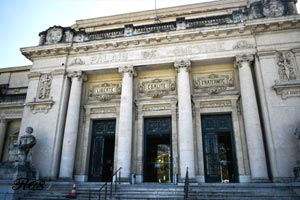 |
National Assembly : collective deliberation. |
Courthouse : law and justice. |
As we have seen with regard to language, collective behaviours are too diverse to have been encoded in our genes. Each society has evolved over the course of millennia, and their isolation has led them to establish very different rules. Indeed, in order to survive, some societies have developed an understanding of nature and agriculture. Others have deemed it more effective to appropriate existing resources and have incorporated warfare into their way of life.
As we have seen with regard to our cells, which are made ill by our lifestyle habits, adult human beings are not immune to social habits.
To understand the processes of social adaptation and the dysfunctions experienced by children and young adults, we must therefore bear in mind that their identity must find its place within a community of millions of individuals within a nation, and of billions within the global population.
So, if every cell in their body is capable of doing something, would a human being be incapable of doing the same ?
Is a human being – the result of the cooperation of 37 thousand billion cells – less intelligent than a single one of them ?
c – Anarchy :
Among young people, it is evident that a sense of unease is often expressed through violence. Having not yet come to terms with the validity of social rules, they naturally tend to impose their will at a time when they are asserting their individuality.
Their grievances against society will then lead them to identify with a group that appears to share their own convictions.
Unable to make their needs heard, they will seek to destroy the system they deem oppressive, or to build their own system within the territory they have claimed for themselves.
Whilst they certainly possess a sense of solidarity and reject inequality and injustice, they do not accept that their freedom ends where another’s begins.
d - Society’s control over individuals :
In the human world, every nation has its own ‘immune system’: the army, the police, militias…
Armies monitor the environment beyond national borders and adapt their weaponry in response to concerns, forecasts or actual needs.
Within national borders, the police are also present to protect the population from harmful individuals.
Similarly, social services step in to help the sick or those in difficulty.
Firefighters, too, act, regardless of the danger, to protect people and property.
As for tax officials, they are also there to collect a share of people’s wealth. This levy helps to ensure the general functioning of society, which in turn preserves everyone’s wealth: roads are essential for getting to work and for supporting industry and trade; pavements provide access to shops; and useful information helps people plan their day.
In a truly democratic state, much like a living organism, all these functions must serve the general welfare, just as all bodily functions exist solely for the health and well-being of all the cells.
e - Circumventing the rules :
A parallel could be drawn between « young » cancer cells that escape the immune system’s control, and young people in neighbourhoods who escape society’s control : whether because they have not received the necessary parental or social upbringing, or because they are rebelling against flagrant injustices (and sometimes for all these reasons), they reject collective rules and carve out territories for themselves in vulnerable areas.
Gathered together as a community in these areas, these young people will establish their own order there. The police will find it difficult to gain access, particularly as they are held back by the de facto protection afforded by the community to its children..
 |
 |
Exclusion zone. |
Drug dealing hotspot. |
These territories will gradually expand, taking in other vulnerable groups who feed off the « nutrients » available to them, in this case, drug money.
We are seeing a gradual spread of these drug dealing hotspots across the country.
f - Society’s influence on the individual :
If addressed in time, the problems affecting some young people could be corrected through an education that reinforces their innate moral sense. However, this would require the community to set an example. But when the deviant behaviour observed in adults becomes part of their own habits, only repressive measures seem appropriate… with rebellion as the inevitable consequence.
Could the adult environment therefore be responsible for this state of affairs, whether this influence stems from a toxic immediate environment or from cultural ideologies ?
g - How does anti-social behaviour develop ?
For young people to rebel against society, they must have accumulated a sufficient sense of injustice without having seen any genuine effort to redress it. It is true that whilst a law is relatively easy to enact, it takes much longer to see attitudes change within a community.
Over the years, the proliferation of bad examples, exposure to toxic influences and injustices, combined with the weakening of society’s protective mechanisms, exacerbate the situation.
Adults’ failure to take injustice seriously, as well as the deplorable example they sometimes set in the exercise of power, play a decisive role in shaping young people’s behaviour.
And let us not forget the influence of misleading advertising when it comes to selling addictive products that are found to cause health problems : should the profits made not be used to fund the necessary medical care ?
As in the case of cancer, where lifestyle improvements could help reduce its incidence, it could be crucial for society as a whole – and even more so for world leaders – to set an example to young people of the kinds of behaviour they have all too often neglected.
h - The influence of external assaults :
We have seen, in the case of cancer, that negligence can be a decisive factor in its onset. Addictive pleasures (tobacco, alcohol, etc.) take precedence over a healthy lifestyle.
At the level of nations, this negligence consists of failing to anticipate an attack, or forgetting that cooperation between nations contributes to the strength of the whole.
We then discover that human conflicts are similar to pathological mechanisms within the body.
Thus, humanity as a whole can be likened to a living organism in which each nation is an organ.
Yet within this living organism, just as with cells in the body, humankind coexists with millions of species.
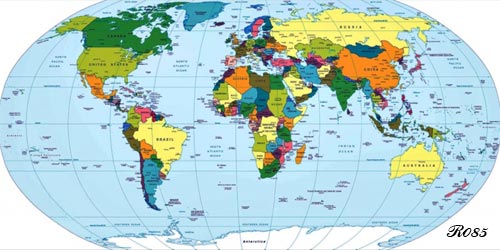
We have seen that a disease can arise in the body and its organs as a result of an external attack; the same is true of a nation.
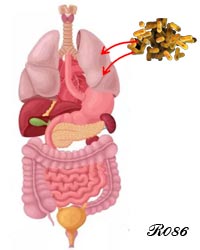
In the human body, when a serious infection arises that could lead to death, external medical assistance must be provided : antibiotics are essential to combat the infection and, where necessary, oxygen therapy supports general bodily functions.
In any case, for health to be restored, the aggression must necessarily cease..
Within the body, all the organs work together to sustain life. The death of one of them disrupts the whole system, or may even lead to the death of all the others.
What would happen if one organ were to attack another? Fortunately, this is not the case. But what does not exist between the body’s organs unfortunately does exist between nations.
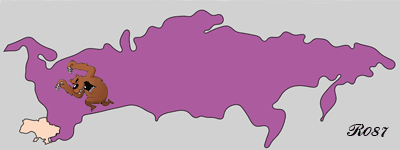
In such cases, we see the same processes at work as in an infection or cancer:
- one or more parts of a nation may be invaded,
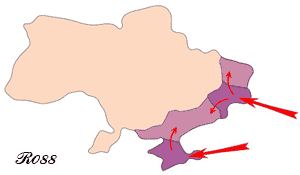
- and colonisation may spread like metastases. In the absence of external aid, the indigenous populations will gradually disappear, until the pre-existing nation itself ceases to exist – a phenomenon that History has recounted to us since time immemorial.
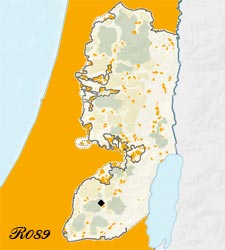
A nation that is too weak can, in fact, only survive with external aid, which will provide it with the weapons to defend itself and the financial resources to manage administrative functions and sustain the economy.
Here again, only the action of an international organisation underpinned by the moral compass and sense of justice of all its members would prove decisive.
For the time being, human beings remain unable to achieve this.
i - What, then, should be done ?
Two approaches are currently being promoted.
– the human approach :
At a physical level, one cannot overcome cancer without killing the invasive cells. This takes its toll on the body, but recovery comes at this price.
At the level of nations, one cannot escape colonisation without resorting to violence, which instils in children a sense of injustice and rebellion that can persist for generations.
Furthermore, in the face of aggression, only the strongest has the power to bring the conflict to an end. But this is a matter of moral strength.
Few colonial empires have agreed to return conquered territories to their rightful owners. To achieve this, there must be an understanding – or even a willingness – to relinquish the wealth of previously conquered territories.
In the case of cancer, eradication takes precedence over treatment; similarly, in human societies, war seems a far easier solution than dialogue once empathy has been lost.
- that of Nature :
It reveals this to us through the paths it took even before the emergence of humankind :
- it has enabled us to discover billions of particles, all different, each with its own specific function [see: the birth of the Universe],
- it has shown us that the combination of all these elements leads to a result that is both constructive and evolutionary.
- finally, it has taught us that life cannot exist without the capacity to feel, and that it cannot survive without respect for the living world.
Life emerged with the introduction of sensitivity into the material world. It is through respect that life has been able to flourish.
Later, by naming things and actions, « Insensatus » forgot that naming things is not the same as experiencing them.
without the capacity for empathy, it cannot survive. »
3 - The microbiota : (continued)
(...)
Bibliography :