
 |
 |
« Reality is the only thing that is real. »
Movie : « Ready player one » S. Spielberg. |
From the flow of life
to human graphic art.
5 - What do the scriptures reveal ?
A – The living environment and abstraction in Mesopotamia :
B – The evolution of writing in Egypt :
a - Writing and the meaning of reading :
b - From sensory expression to symbols :
c - Seals and their place in society :
d - Through pottery, humankind discovers art :
e - The evolution of human capabilities throughout prehistory :

5 - What have all these graphic representations taught us ?
A - The living environment and abstraction in Mesopotamia :
The transformation of proto-cuneiform into alphabetic writing has allowed us to grasp the importance of writing in the development of city-states in the Middle East. In just 1,500 years, the need to trade and communicate necessitated the abandonment of pictograms, leading to the development of alphabetic writing.However, this ability to replace images with abstract symbols never served any purpose other than to describe reality.
We have also wondered about the evolution of this writing system. Might we not find elements within it that describe the lived experiences of the people of that era?
We have been able to gain insight into their sense of relationships and their sensitivity by discovering the legacy they left us, such as the body surrounded by flowers in the Shanidar Cave.
The Neolithic period that followed tells us little about writing but reveals a great artistic sensibility. Following paintings and sculptures, pottery—regardless of the region—was decorated with varied motifs.
Then the first forms of graphic art emerged. By examining clay tablets featuring groups of objects engraved within frames, we can see that the organization of society followed the same pattern.
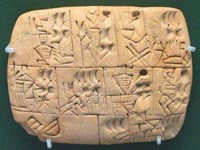
Ideograms inscribed within frames,
indicating the daily beer rations for workers
(3300–3000 BCE). British Museum.
indicating the daily beer rations for workers
(3300–3000 BCE). British Museum.
We have not forgotten that people learn by drawing parallels with what they already know.
Just as the family fits within the framework of the home and homes are built within the framework of the city, writing is organized in a similar way.

The family fits within the framework of the home.

The home is part of the city.
The evolution of writing continues : frames not only delineate information, but they also reveal the context of life.
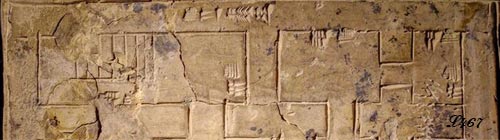
Construction plan.
Then cuneiform writing emerged. The family framework gave way to a broader community. The signs are no longer inscribed within a frame ; they are arranged in a linear sequence. To simplify reading, the signs are organized and follow a line that is interrupted only when everything has been said.
Writing will now be inscribed on a horizontal line, much like travel within a city or along the roads connecting the different regions of a state.

Babylonian text (read from left to right).

For city dwellers, it is now easier to take in their immediate surroundings than to look up at the sky.
In terms of writing, everything is now in place to meet the needs of the community.
Thus, texts are becoming longer to define rules of conduct at the expense of individual instinctive reactions.
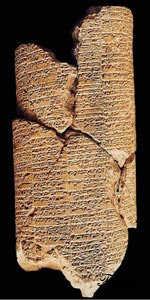
The first legal code,
created by Ur-Namma between 2100 and 2050 BCE.
created by Ur-Namma between 2100 and 2050 BCE.
At the highest level of abstraction, written language becomes incomprehensible to the uninitiated, whilst it enters the world of geometry and mathematics to give meaning to inaccessible realms.
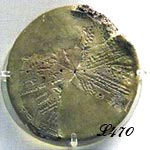
Circular tablet depicting a celestial planisphere indicating the positions of the constellations.
British Museum.
British Museum.
Over the course of 3,000 years, peoples would share their cultural riches, and this new form of writing would be adopted by a dozen languages.
« Whether expressed through images or abstract signs,
all language retains its function of describing lived experience and reality. »
all language retains its function of describing lived experience and reality. »
A look back at the past.
From abstract language to the language of dreams.
From abstract language to the language of dreams.
7 - Abstraction : it diverted the brain’s processing away from visualizing images of the world.
-
-
-
-
-
1 - The language of dreams.
B – The Evolution of Writing in Egypt :
a - Writing and the Meaning of Reading :
Let us set aside for now the gradual transformation of images into writing and focus instead on the different ways in which signs are inscribed and read.
Mesopotamian writing, which very quickly became symbolic, provides no clues regarding the direction of writing. The evolution of Egyptian writing, which involves the use of images, is more explicit in this regard.
The connection to the living world is evident in the way texts are read. Indeed, hieroglyphs can be read both vertically and horizontally, but it is the gaze of an animal or a figure that indicates the direction of reading.
If hieroglyphs are written on a horizontal line, an animal’s gaze directed to the left indicates that the text is read from left to right. Conversely, if the animal’s or figure’s gaze is directed to the right, the text is read from right to left, toward the figure.
In the case of a column, the text is always read from top to bottom, but following the rule of the gaze: the movement created by reading always proceeds toward the observer—in this case, the figure or animal.

Reading direction starting from the top.
The arrows indicate that the reading direction may change when moving from one column to another.
The arrows indicate that the reading direction may change when moving from one column to another.

Reading direction, reversed on either side of a tomb’s entrance.
Our exploration of the origins of language has led us to understand that seeing and hearing are essential for survival, but that the act of seeing—which allows us to anticipate situations before we encounter them—is the most important.
How did vision play a role in promoting the development of writing ?
We have determined that the living world served as the inspiration for the earliest graphic representations [see : rock art]. But when it comes to Egyptian writing, how were the rules establisheds ?
As we have seen, there are two :
- The first is that, within a column, hieroglyphs are always read from top to bottom.
- The second requires observing which direction the depicted living beings are facing in order to access the written information.
It is therefore the living beings that determine how to read the sequence of signs, since these signs are read by moving toward the direction of their gaze.
Why are the directions taken by the writing so varied ?
No doubt because, in reality, all directions are used : rain falls downward, a bird flies up or down, an animal moves from right to left or from left to right.
Let’s imagine, then, a person looking up at a bird descending toward them.
How, then, can we describe this image with words and then arrange them in a vertical column ?
 |
 |
A bird of prey is descending toward the ground. |
We can see, then, that the direction adopted by Egyptian writing is one of approach. In our example, the bird in flight is descending toward the observer. On the other hand, a bird that takes flight and moves away is not included in the direction of reading ; we will see why later.
Let us now examine the sentences written on a horizontal line.
 |
 |
A tiger is approaching the observer. |
 |
 |
A wolf is threatening the observer. |
Thus, from the outset, the direction of reading depends on the perceived environment.
Why approaching rather than moving away ? Undoubtedly because directions related to survival dictated this in everyday life.
Indeed, the approach of a danger warrants paying attention and observing the situation before reacting, just as a written warning warrants being deciphered.
Similarly, the pleasure experienced when a friend approaches captures one’s attention, much like a letter filled with kind words.

On the contrary, a danger or a friend moving away loses its interest. The encounter belongs to the past, and one’s gaze can turn toward other horizons.
Undoubtedly, humans were initially the privileged observers who determined the direction of reading in texts, but any animal could subsequently take their place.
It is also possible to write in an upward direction, but few writing systems follow this movement.
If we were to watch a spider climbing up our leg, its path could be described by a sentence that rises toward the character’s gaze.
 |
 |
Indeed, a drawing can be created in any way: it always adapts to the medium. It is when it transforms into a symbolic sign for writing that practical considerations will determine the stroke and direction, and these will be ratified by the community.
While Egyptian writing does not follow a bottom-to-top reading direction, other peoples have employed entirely free-form directions.
This trend can be seen in Ogham script, used in Ireland between the 4th and 9th centuries. Its alphabet consists of notches carved along a vertical line that follows the edge of the rock.
 |
 |
Ogham stone. Ireland.
Transliteration : Na maqui Lugudeca muc Cunea.
Translation : The sons of Lugudeca, son of Cunea.
Transliteration : Na maqui Lugudeca muc Cunea.
Translation : The sons of Lugudeca, son of Cunea.
Even in this case, the rule conforms to the reality of the environment : the line that determines the direction of writing adapts to the surface, just as living beings follow the undulations of their environment.

Other writing systems are written from bottom to top or follow various directions.
- The Hanunóo script, dating back about 1,300 years and used by the Hanunóo people living on the island of Mindoro in the Philippines, is written from bottom to top.
- Libyco-Berber, an ancient geometric script used in Berber societies in North Africa, dates back to the 2nd millennium BCE. It is generally found on tombstones and is also written from bottom to top.
- Rongorongo is a system of signs carved into wood. Discovered on Easter Island, it is written in reverse boustrophedon. Each line, which is reversed relative to the previous one, requires the writing surface to be turned over for each new line.
- In Tuareg writing, the direction of writing is traditionally vertical, moving upward, but it also uses all other possible directions, including boustrophedon and spiral.

These ancient writings show that the meaning of writing struggled to take root in its early stages.
It evolved over a long period from scattered images on the rock face of a cliff or in a cave before taking the form of symbolic writing. Each stage provided lessons that improved its practicality while adapting it as closely as possible to the spoken language.
Generally speaking, having proven its worth, linear writing today follows two main orientations :
- vertical for traditional pictograms, ideograms, and calligraphy,
- horizontal for alphabetic scripts and all commonly used writing systems.
b - From sensory expression [*] to symbols :
1 - The world becomes frozen in its representation :
Another development has shaped graphic design. The living, animated world of cave paintings and engravings has disappeared.
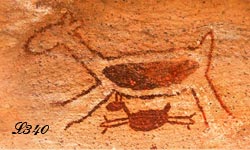 |
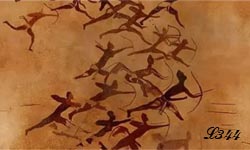 |
The living world.
Although this world continues to exist in reality, its various elements appear frozen and fragmented in writing.
Human beings have left the natural world to become part of a world where the collective dominates and requires specialists dedicated to a single task: thus, in writing, we find symbols signifying man, woman, animal, eye, scribe, and deity without always representing them…
Each symbol now has its own meaning and is part of a system of symbols that captures all the subtleties of language.

The world of symbols.
2 - The line, a staple of children’s writing, supports the text :
In Egyptian writing, lines were then added, as we observed in Mesopotamian texts.

Egyptian writing.

Mesopotamian writing.
Information that is isolated from the general context is rare. When present within a cartouche, it is reserved for influential figures.

Royal cartouche of Ramses II.
These lines and frames now limit the spontaneity of the graphic movement.
Writing no longer describes the gestures and emotions expressed in the images.
It describes situations that are part of established behaviors.
The same is true for a child’s learning to write, which leads them to control their spontaneity in order to adopt the writing style of their group. A line will guide their first attempts.

From spontaneous expression…
 |
 |
…to social learning.
We can see, then, that the evolution of writing over millennia follows the same path as a child’s drawing : the child begins by discovering the line, then expresses his or her inner world through images before moving on writing.
In Egypt, images depicting events are inscribed on the same linear media.
 |
 |
The Earth’s surface, the place where humans live, is represented by a line.
As we have seen in Mesopotamian writing, the horizontal line perfectly describes the human horizon in a world where movement takes place on a flat surface.
As this evolution neared its end, with these conventions now firmly established, the line became unnecessary, and writing took on its final form.

Hieratic writing.
We can thus observe that living beings
- inspired the creation of paintings and later hieroglyphs,
- that their movements determined the direction of reading,
- and finally that their medium determined the line, the guide for writing.
This transformation of graphic representation highlights a similar evolution in language. Through vocalizations, language began to express emotions, then evolved to describe increasingly complex situations.
Gradually, by describing the situations and behaviors dictated by communal life, words even came to convey the existence of an emotion (for example: “I’m afraid of dying”) without, however, evoking the listener’s empathy.
3 - A special case is that of the quadrats :
Although they delimit spaces within the text, they are not closed off, as we saw in the early stages of cuneiform writing.
|
 |
Proto-cuneiform. |
Hieroglyphs. |
These frames have varied shapes and delimit families of signs : the reading order of these signs within the frame is independent of the text’s general reading direction. It can even be reversed to preserve the text’s aesthetic.
The disappearance of the framing lines that existed in proto-cuneiform writing could indicate a relatively free integration of the individual and their family into the functioning of the group.
Ultimately, Egyptian writing would evolve toward abstract forms capable of describing all events without representing them.
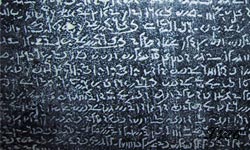
Demotic script (Rosetta Stone).
We can thus observe that writing systems evolved in almost identical ways in Egypt and Mesopotamia, indicating that human thought follows the same evolutionary path across all peoples:
- simplification of images to facilitate the rapid transmission of information,
- gradual abandonment of these same images,
- increased precision of the word represented by the symbol through the addition of prefixes or suffixes,
- representation of sounds and ideas,
- establishing common rules to make information accessible to all.
Like a child in the early years of life, humanity has the capacity to adapt to any situation. It is only the media and tools used – dictated by the environment – that vary.
« The development of writing marks, for humankind,
the abandonment of the natural environment. »
the abandonment of the natural environment. »
A return to the past.
From abstract language to the language of dreams.
From abstract language to the language of dreams.
7 - Abstraction : it has diverted the brain’s functioning away from perceiving images of the world.
6 - The abandonment of the natural world in favour of the city has reinforced the human brain’s orientation towards abstraction.
-
-
-
-
1 - The language of dreams.
In Mesopotamia, cuneiform writing reveals nothing about its origins or development ; it merely reflects the organisation of life within the city. Egypt, on the other hand, has enabled us to understand that writing developed through the observation of events..

If we look closely at the sequence of events, we see that, having been influenced by the environment, writing evolved towards abstraction. During the same period, humankind moved away from the natural world towards that of collective organisation.
We may therefore wonder about the evolution of communication prior to the first rudimentary forms of writing.
How did this evolution take place ?
c - Seals and their place in society :

Seals mark a pivotal period in the transformation of society.
Their development highlights the essential role of administration and religion. They embody a characteristic common to all forms of writing, as well as an aesthetic sensibility linked to the enduring depictions of the natural environment.
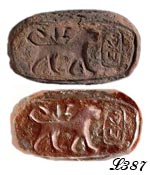
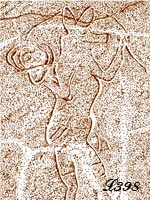
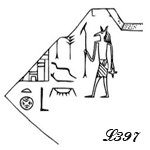
At the same time, archaic Egyptian art reveals a shift in thinking : humankind moves from a world in which it was part of nature to one in which it begins to assert its power over it. The living world, hitherto depicted as closely as possible to reality, became hybrid : animals acquired human abilities, and humans recognised themselves as animals [see: Ancient Egypt - in french].
The combination of the two brought humankind closer to the gods.
 |
 |
d -Through pottery, humankind discovered art :
Long before writing, we witness the birth of art and the first marks engraved on jars : potmarks.

These consist of simple lines, bird tracks or stylised animals, which became widespread with the development of trade and the need to keep track of and catalogue goods.

At around the same time, decorations began to appear on c-wares et d-wares.

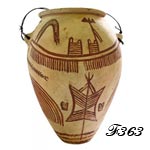
The decorative motifs on pottery from Neolithic Egypt reveal a marked artistic development among the Egyptians. The same is true of Mesopotamian pottery.
However, as we have already mentioned, these images gradually became more static as they evolved.
 |
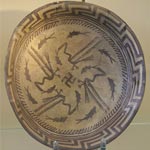 |
Jar from the tomb of the Scorpion King. Egypt. |
Pottery from Samarra. Mesopotamia. |
- the ability to make the most of one’s environment,
- the ability to create forms that vary according to need,
- the ability to vary decorative motifs : the design is intended to be decorative and also provides us with information.
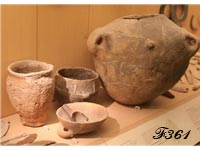
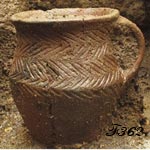
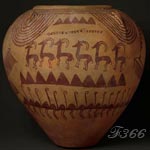
We can see the similarity between the artistic development of these peoples and that observed today in children.
 |
 |
 |
Creation of a functional object. |
Simple decoration. |
Use of dyes. |
We can therefore observe that sensitivity takes precedence in the representations that predate the emergence of writing, but that ‘artistic’ development corresponds to images that evoke reality but are no longer reality itself.

From Homo sapiens to modern man, our view of the world has changed.
Sensitivity seems to have been transformed.
Sensitivity seems to have been transformed.
« Artistic expression becomes more refined. »
A return to the past.
From abstract language to the language of dreams.
From abstract language to the language of dreams.
7 - Abstraction: it has diverted the brain’s functioning away from perceiving images of the world.
6 - The shift away from the natural world towards urban life has reinforced the brain’s orientation towards abstraction.
5 - Artistic sensibility replaces the concrete representation of the world.
-
-
-
1 - The language of dreams.
e - The evolution of human capabilities during prehistory :
What were humanity’s achievements before the invention of pottery and the emergence of artistic talent?
Their creations demonstrated a marked manual dexterity and the ability to invent new forms.
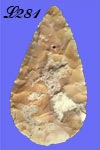
This dexterity coincides with the manufacture of the first stone tools, the bifaces, which appeared nearly 2 million years ago. The development of tools adapted to multiple uses demonstrates not only the capacity to innovate and imitate, but also to communicate.
 |
 |
Hand-axe. |
Various tools : scrapers, knives, spearheads, chisels and hammers. |
What were the earliest manifestations of communication ?
A language may consist solely of vocalisations, just as effective as that of Campbell’s mone or the chimpanzee, whose full range of nuances we are far from being able to distinguish.
All the animals that live alongside us are curious by nature. It is indeed necessary to discover the many facets of the world in order to determine what is dangerous or useful. As the human hand became functional at a very early stage, shapes could be created, just as a child does in the sand.
Sometimes, by chance, these shapes might have resembled real objects or figures, a phenomenon known as pareidolia.
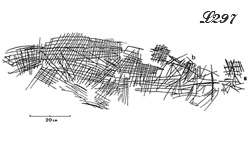
The earliest markings appear to be the result of humankind’s initial trial and error.
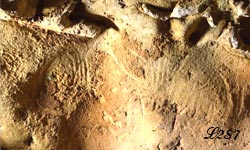
Fingerprints.
Following random markings on a soft surface, engravings began to appear on harder surfaces, and the range of tools expanded to achieve the desired result.
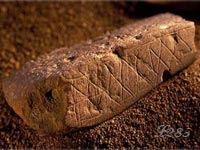
Ochre block. Blombos.
These tools made it possible to vary the shapes…
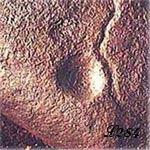
Cup mark. Bhimbetka.
…and even to depict what the eye could see.
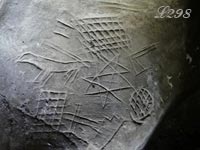 |
 |
At the same time, counting marks have revealed another aspect of language development and the brain’s ability to go beyond the number of fingers on one hand. However, this ability required visualising the numbers on a surface. Isn’t that what a child does when counting on their fingers ?
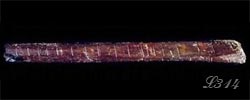
« During this period,
individual development takes place alongside collective development. »
individual development takes place alongside collective development. »
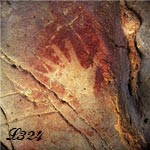
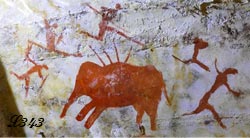
In another era and in other lands, the ochre found at these sites enabled the painter to assert their identity through their handprint, and to bear witness to their own existence.
Through these images, he gradually reveals to us all aspects of his personality: and in particular, the evolution of his sensibility.
|
 |
 |
« As manual dexterity develops,
the brain discovers and refines its representations of reality.
Furthermore, it seems to have become capable of representing numbers using dots or lines. »
the brain discovers and refines its representations of reality.
Furthermore, it seems to have become capable of representing numbers using dots or lines. »
« Man asserts his identity within the group,
and he represents the reality that surrounds him. »
and he represents the reality that surrounds him. »
A return to the past.
From abstract language to the language of dreams..
From abstract language to the language of dreams..
7 - The evolution of writing is complete.
Abstraction has diverted the brain’s focus away from perceiving images of the world.
The image has lost its value as a form of language.
6 - The shift away from the natural world towards the city has reinforced the brain’s orientation towards abstraction.
5 - Artistic meaning replaces the concrete representation of the world.
Images, whether tentative or expressive, describe the perception of another world.
4 - Man is integrated into the natural world and describes only what is; this is the condition of his survival.
Images, whether tentative or expressive, describe his perception of the real world.
-
-
1 - The language of dreams.
From abstract language to the language of the senses : (continued in french)
Bibliography :