
 |
 |
«A people who are illiterate, without writing, without memory,
are a people without history. » Jean-Marie Adiaffi, Ivorian writer (1941-1999). |
The transition from pictographs to writing
in Egypt and Mesopotamia.
A - Prehistory :
a - The Paleolithic :
b - The Neolithic - pottery (between 7000 and 5000 BCE) :
B – The Turning Point in History - the emergence of writing :
a - The conditions for the emergence of writing :
b - The beginnings of writing in Mesopotamia :
- Proto-Elamite : (between 3300 and 3000 BC)
- Proto-cuneiform :
- Pictographic writing :
- Ideographic writing :
c - The birth of cuneiform writing :
- Phonetic writing :
- The Phoenician alphabet :
C – The social and scientific contributions of writing :
a - The organization of social life :
b - The development of science :

4b – De l’art rupestre à l’écriture, l’évolution de la représentation graphique en Mésopotamie :
A - La préhistoire :
The Early Paleolithic (approximately – 800000 à – 300000)
The Middle Paleolithic (approximately – 300000 à – 40000),
The Upper Paleolithic (approximately – 40000 à – 9500), figurative art makes its appearance.
Mesolithic -9600
Neolithic -6000 Poteries
Bronze Age -2300
Iron Age -800
Antiquity -50
Middle Ages 500
Modern Era 1500
Contemporary Era 1789
The Middle Paleolithic (approximately – 300000 à – 40000),
The Upper Paleolithic (approximately – 40000 à – 9500), figurative art makes its appearance.
Mesolithic -9600
Neolithic -6000 Poteries
Bronze Age -2300
Iron Age -800
Antiquity -50
Middle Ages 500
Modern Era 1500
Contemporary Era 1789
a - The Paleolithic :
The prehistory of Mesopotamia is centered around the Tigris and Euphrates rivers and in the surrounding areas of the Zagros Mountains, Anatolia, and Syria.
During the Middle Paleolithic, hunter-gatherers lived in the caves of the Zagros Mountains and, seasonally, on the alluvial plains. They left behind stone tools (primarily scrapers and denticulates), and funerary remains, such as a body surrounded by flowers found in the Shanidar Cave, which indicates the care given to members of the community.
Unlike most regions of the world, rock art in Mesopotamia is underdeveloped.
Few examples of painting survive; however, geometric figures and mythological creatures are found.
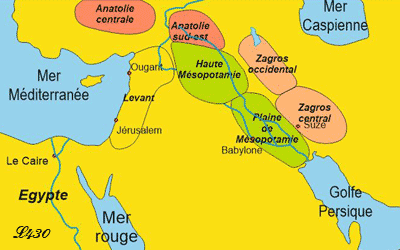
In the Zagros region, sculptures, paintings, and human figures have been unearthed. However, in southern Mesopotamia, most of the remains have been buried under alluvial deposits.
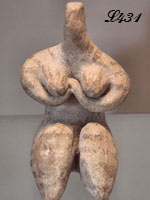
Seated female figure.
Samarra, 6th millennium BCE (Location on map).
Samarra, 6th millennium BCE (Location on map).
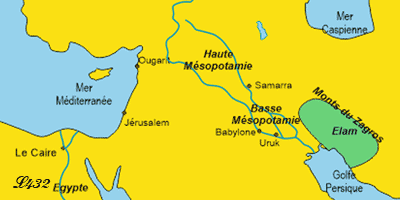
Mesopotamia is now recognized as the cradle of writing, but how did it come to be ?
b - The Neolithic Period - Pottery (between 7000 and 5000 BCE) :
During the pre-ceramic Neolithic period, inhabitants used stone containers until the advent of pottery around 6000 BCE.
The availability of clay then facilitated the production of containers for foodstuffs and allowed for the marking of goods exchanged between trading communities. As we have seen in Egypt, we find here the importance of portable media in the development of writing.
A period then began in which pottery became prevalent, particularly at sites such as Jarmo and Tell Hassuna.
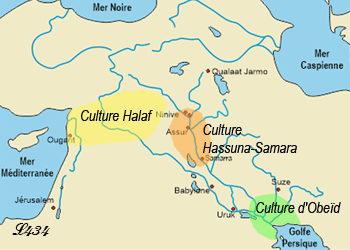
This development occurred in a similar manner across different regions :
- Hassuna Culture : (6000 to 5000 BC)
We find utilitarian pottery and ceramics decorated with incisions.
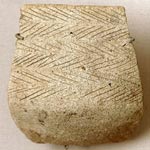
Vase with incised decorations from the Hassuna culture.
- Samarra Culture : (6200 to 5700 BC.)
Decorative motifs became more refined, featuring animal, human, and geometric designs.
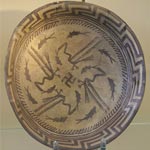
Fine pottery from the Samarra period,
Pergamon Museum, Berlin.
Pergamon Museum, Berlin.
- Halaf culture : (6000 to 5100 BC).
In its final phase, new forms emerge, and the painting becomes polychrome.
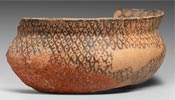
Ceramic bowl from the Halaf culture.
- Obeid culture : (5300 to 4700 BC) 6500 to 3750 according to Wikipedia
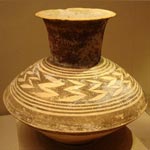
Obeid pottery 3,
Louvre Museum, AO 2959838
Louvre Museum, AO 2959838
B – The Turning Point in History – The Emergence of Writing :
The Lower Paleolithic (approximately 800,000–300,000 BCE)
The Middle Paleolithic (approximately 300,000–40,000 BCE),
The Upper Paleolithic (approximately 40,000–9,500 BCE), figurative art makes its appearance.
Mesolithic -9600
Neolithic -6000 Pottery
Bronze Age -2300
Iron Age -800
Antiquity -50
Middle Ages 500
Modern Era 1500
Contemporary Era 1789
The Middle Paleolithic (approximately 300,000–40,000 BCE),
The Upper Paleolithic (approximately 40,000–9,500 BCE), figurative art makes its appearance.
Mesolithic -9600
Neolithic -6000 Pottery
Bronze Age -2300
Iron Age -800
Antiquity -50
Middle Ages 500
Modern Era 1500
Contemporary Era 1789
a - The conditions for the emergence of writing :
Toward the end of the 4th millennium BCE, villages that grew into cities imposed rules established by a powerful ruling elite. The establishment of vast city-states such as Uruk saw the gradual emergence of writing as a means of communication.
Writing marks the end of Prehistory and the beginning of History.
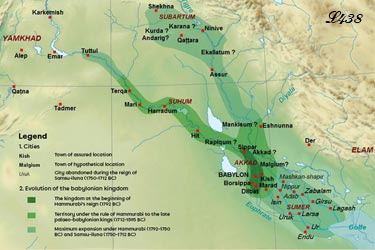
City-states in the alluvial plain.
Thus, the emergence of writing appears to be closely linked to the conditions of life in society.
Added to this are the defining characteristics of the environment, such as the rocks used for rock engravings and the pigments used in cave art.
In Mesopotamia, three conditions favored the emergence of writing :
- a medium that was easy to use and easily transportable : clay, the equivalent of papyrus. This medium and the writing tool, the reed, were provided by the natural environment.
This clay was so significant that it gave rise to a creation myth in which man was fashioned from clay, like an artist’s statuette.
- city-states that require a rigorous social organization. Politically, these cities are all independent of one another. They act autonomously and possess the same powers as a state covering a large territory. Ancient Mesopotamia saw the birth and growth of many such cities within its borders: Babylon and Ur are the best-known examples.
- trade, which requires the recording and accounting of exchanges.
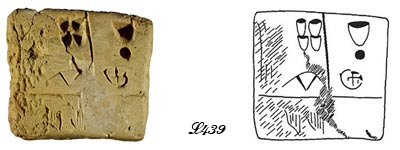
Pictogram symbolizing a sheep.
This is how the Sumerian civilization, after giving rise to the first cities, was able to flourish and dominate the region for two millennia.
With the advent of writing, humanity left prehistory and entered the historical period.
b - The beginnings of writing in Mesopotamia :
- Proto-Elamite : (between 3300 and 3000 BCE)
In a region neighboring Mesopotamia, primarily in the city of Susa, an original form of writing emerged, inscribed on clay : Proto-Elamite. Composed of figurative or abstract signs, it was written from right to left.
These early signs, which preceded cuneiform writing, could represent either a word (logogram) or an idea (ideogram). The image could be realistic or extremely simplified, such as that of a sheep reduced to a simple cross in the center of a circle, which might denote its pen.
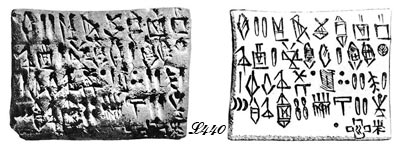
Accounting tablet in Proto-Elamite (3300–2800 BCE).
his script, known as “Proto-Elamite,” did not have any successors.
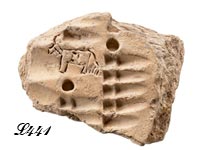
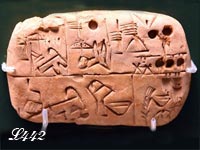
Proto-cuneiform administrative tablet concerning the distribution of rations.
Uruk III phase (c. 3200–3000 BCE). British Museum.
Uruk III phase (c. 3200–3000 BCE). British Museum.
While a single moment in time could be accurately depicted, it was impossible to convey how that moment evolved. Much like language in its early stages, the signs and their combinations at that time resembled a primitive pidgin-like language [cf : le protolangage] more than a fully developed language.
On the other hand, this Proto-Elamite was perfectly suited for trade, presenting a range of goods destined to travel and reach their recipients.
Before evolving into cuneiform—a script attesting to a sophisticated language—the writing system had to adapt to better convey the expression of sounds and thought.
- Proto-Cuneiform :
Appearing at the same time as Proto-Elamite, it is found on clay tablets primarily in Uruk, the main city-state of that period. As the ancestor of cuneiform, this archaic script differs from it in its more linear form and the near absence of phonetic signs.
The signs that make up Proto-Cuneiform also consist of logographic signs representing words, and numerical signs used to quantify objects, areas, volumes, and duration.
These texts, primarily administrative in nature, record the movement of goods, keep track of them, and specify the sender and recipient.
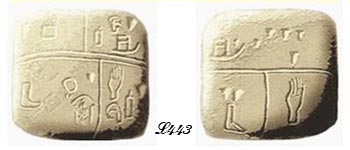
Pictograms from the Kish Tablet (circa 3500 BCE).
Ashmolean Museum - Oxford (Great Britain).
Ashmolean Museum - Oxford (Great Britain).
The key advantage over petroglyphs is the ability to quickly record information using a stylized representation, and then modify or erase it as needed—just as we do today with paper.
Standardized and arranged in a consistent order, the symbols covering these tablets also confirm that this is a form of writing.
The spread of these documents throughout the Mesopotamian basin and neighboring regions suggests that this invention is linked to the emergence of the concept of the state.
- Pictographic writing :
Furthermore, derived from rock art, pictographic writing uses miniaturized images, taking advantage of the existence of a portable medium.
The combination of these images allows for the clarification of information.
Although Mesopotamian and Egyptian writing systems have neither the same origin nor the same development, these tablets can be compared to those found in the tomb of the Scorpion King, 3300 BCE. We thus observe a similar development across all human communities seeking communication.
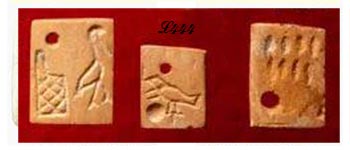
Tablets from the Tomb of the Scorpion King (Egypt).
However, the emergence of writing itself depends primarily on the level of development of the community and its needs (religion, trade, administration...).
- Ideographic writing :
More advanced, ideographic writing is a system that now conveys not only words but can also express ideas or concepts.
The sequence of new symbols then describes thought, evoking the original image and the ideas that stem from it, the situations we imagine—in other words, everything the mind can conceive.
Thus, in the evolution of Sumerian writing, let us examine the representation of the hand: it unambiguously denotes a part of the body
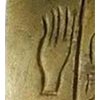
Hand.
But on the tablet where it is engraved, it means “to receive”, and the triangular notches accompanying the objects in the upper compartments represent numbers.
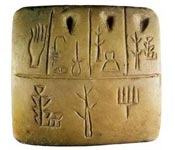
Sumerian proto-cuneiform.
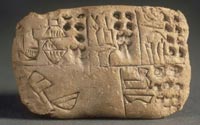
Accounting tablet inscribed in Sumerian ideographic writing.
In the upper section, the ideographic signs are accompanied by numerical signs.
Louvre – Collections.
In the upper section, the ideographic signs are accompanied by numerical signs.
Louvre – Collections.
On these tablets, the signs are arranged in boxes, like a series of juxtaposed tablets, which makes them easier to read.
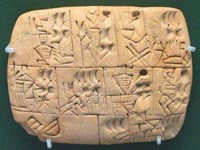
Ideograms indicating the daily beer rations for workers
(3300–3000 BCE).
British Museum.
(3300–3000 BCE).
British Museum.
We can see that numerical symbols are represented in two ways : notches and circles.
c - The emergence of cuneiform writing :
- The transformation of symbols :
During the first half of the 3rd millennium BCE, this ideographic writing system was broken down into elements resembling small “nails.” This made writing faster and allowed syllables to be isolated.
Created by pressing a reed stylus (the calamus) onto a clay tablet, four types of signs were selected : horizontal, vertical, oblique, and the isolated “head” of a nail.

Calamus.
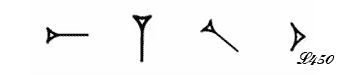
Cuneiform signs.
Over time, a gradual transformation of the signs can be observed.
Previously, most pictograms represented reality. One notices the strong resemblance to children’s drawings, with lines and dots, and the thread-like representation of silhouettes [see : the stick figure].

Pictographic signs.
In the 3rd millennium BCE, the signs underwent a rotation to the left, and they were read from left to right.
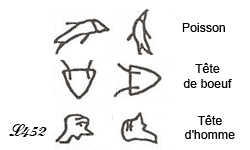
Rotation of the signs.
At the same time, signs began to combine to express the richness of language and thought. Sentences were then written in accordance with the sequence of words in spoken language.
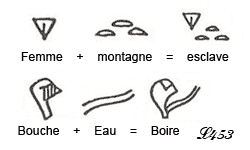
Combination of multiple signs that alter their meaning.
This transformation continues with lines that become straight.
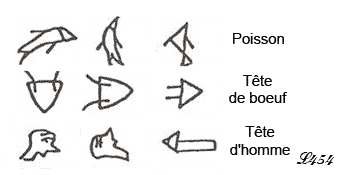
From pictogram to abstract sign. Emergence of cuneiform signs.
Then these signs become simpler and more abstract. This stylization of images accompanies the development of the human brain’s capacity for abstraction.
Humans thus become capable of representing reality in a different way.
The boxes in which the signs were inscribed gradually disappear, and writing becomes linear.
This process continues and refines itself with the emergence of cuneiform signs.
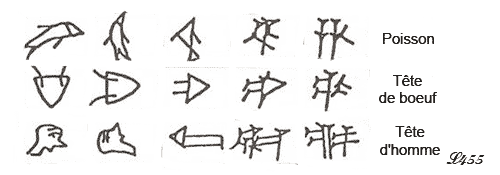
Transformation of pictographic signs into cuneiform signs.
Cuneiform writing then became capable of conveying all the nuances of thought. Its structure allowed it to be adapted for use in other languages, which was the determining factor in its expansion and evolution.
Thus, over the course of more than 3,000 years of existence, cuneiform writing was used by a dozen different languages. However, to achieve such developments, human abstract thinking had to become more sophisticated.
- Phonetic writing :
The transition to cuneiform was accompanied by another major development: thanks to their simplification, the signs came to represent not only actions but also individual sounds or the sounds of a syllable. Thus, Sumerian became the first language to use a syllabic script; this innovation was later adopted by neighboring languages.
This innovation made it possible to reduce the number of symbols used. The transmission of information in writing was thereby facilitated, and a clearer expression of the spoken language became possible. This innovation paved the way for the writing systems we know today.
Around the mid-17th century BCE, the cuneiform system was adapted by a people of Central Anatolia, the Hittites, to write their own language.
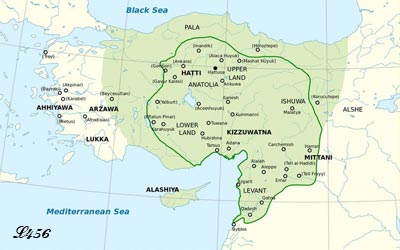
The Hittite Empire at its greatest extent.
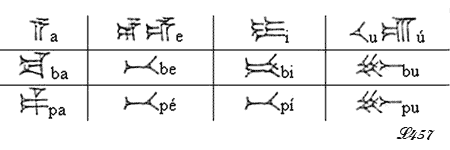
Sounds (a, e, i, u) or syllables (ba, be, bi, bu) of the Hittite syllabary.
V and CV-type phonograms of the Hittite syllabary.
V and CV-type phonograms of the Hittite syllabary.
- The Phoenician alphabet :
The first alphabet emerged in Phoenicia around 1400 BCE. Syllables were then broken down into their individual sounds. The symbols used now represent distinct sounds, allowing syllables to be reconstructed and words to be written.
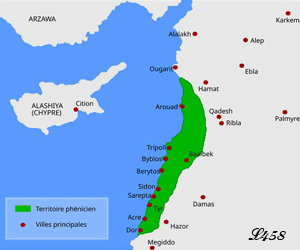
Phoenicia.
The number of phonograms was drastically reduced. This alphabet, which transcribes only consonants, consists of just 22 symbols.
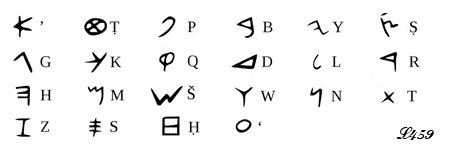
Phoenician alphabet.
This Phoenician alphabet was itself transcribed into cuneiform script.
The first cuneiform alphabet, adapted to the sounds of the local dialect, has thirty signs; it appeared in Ugarit, a trading city on the Syrian coast, between the mid-13th and early 12th centuries BCE.
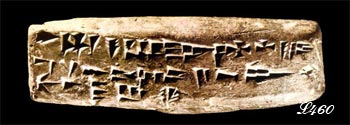
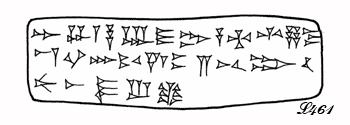
Ugaritic alphabet.
It was in this script that the scribes of Ugarit wrote down their myths and religious rituals, as well as the administrative texts of their kingdom.
The final millennium of cuneiform writing’s existence was the period when language and writing reached their highest level of perfection, enabling scholars to develop and share their knowledge of the world.

Babylonian text (read from left to right).
« While taking different paths,
writing systems began with images reproducing what the eye saw.
Then, they evolved into abstract signs conveying what the ear heard.
Writing then combined the two, allowing the reader
to ‘hear’ the sounds of language represented by writing,
and to ‘visualize’ the situation described by the writer. »
writing systems began with images reproducing what the eye saw.
Then, they evolved into abstract signs conveying what the ear heard.
Writing then combined the two, allowing the reader
to ‘hear’ the sounds of language represented by writing,
and to ‘visualize’ the situation described by the writer. »
Writing enabled the inhabitants of these cities to share a vast amount of knowledge across entirely different fields.
C – The social and scientific contributions of writing :
a - The organization of social life :- Trade :
In expanding societies that needed to develop trade, environmental conditions proved to be decisive (in this case, clay that was easy to mold and reuse). Simple markings on tablets thus made it possible to share information about traded goods between senders and recipients.
« Abstract signs became essential for organizing relationships,
establishing equivalences between goods,
or assigning a market value to labor. »
establishing equivalences between goods,
or assigning a market value to labor. »
- Accounting :
Furthermore, governing a state required the collection of taxes and the valuation of property. Thus, the first signs to appear alongside graphic representations were accounting symbols.
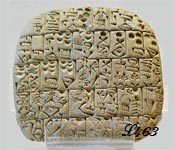
Tablet in archaic cuneiform script concerning the sale of a field and a house.
Shuruppak, c. 2600 B.C. Louvre Museum.
Shuruppak, c. 2600 B.C. Louvre Museum.
« Basic mathematics develops. »
- The protection of the individual and the group :
The development of a state cannot take place without the establishment of rules of conduct that are essential for maintaining order.
Writing is therefore indispensable for organizing the justice system, disseminating its rules, and thus enforcing them throughout the territory.
We owe the creation of the world’s first legal code to the founder of the “Third Dynasty of Ur,” General Ur-Namma.
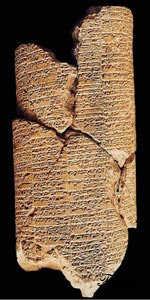
The first legal code,
created by Ur-Namma between 2100 and 2050 BCE.
created by Ur-Namma between 2100 and 2050 BCE.
The beginning of this text describes how Ur-Namma established justice and enforced it, particularly by protecting widows and orphans. It influenced Mesopotamian legal systems until the development of the Code of Hammurabi , named after the Babylonian king who reigned three centuries later.
« Justice is necessary to uphold the dignity of the individual and the state. »
b - The Development of Science :
In addition to writing and accounting, Mesopotamian civilization developed medical knowledge. It also laid the foundations for scientific disciplines by creating various mathematical systems, such as metrology and astronomy. Furthermore, it introduced new concepts such as fractions and positional notation.
- Medicine and individual well-being :
With writing, ancient knowledge can be preserved, and new knowledge shared.
Vocabulary expands. Cuneiform writing, which recorded the first medical prescriptions in history on clay tablets, allows us to discover them today. Medical texts describe diseases and propose remedies, revealing an advanced medical system.
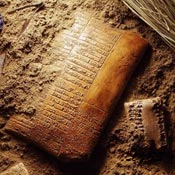
Sumerian cuneiform tablet dating from 2400 B.C.
on which medical prescriptions are inscribed.
on which medical prescriptions are inscribed.
Medicine would incorporate other disciplines such as anatomy and physiology.
By moving beyond the realm of pure oral tradition, this medicine became a science. It involved discoveries and exchanges that would lead to improved outcomes.
However, this science is influenced by human and social factors. Alongside proven, verifiable knowledge, it will continue to employ magical healing rituals, effectively utilizing the placebo effect ahead of its time.
Since healing cannot be separated from its religious aspect, this results in medical practices that combine the use of pharmaceutical remedies with magical objects (incantations, protective objects, etc.).
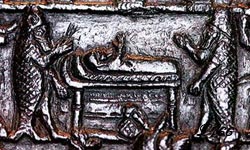
Scene of a patient’s healing, detail from the “Lamashtu Tablet,”
Louvre Museum, 8th century B.C.
Louvre Museum, 8th century B.C.
The most important medical treatise discovered is the “Treatise on Diagnosis and Prognosis,” intended primarily for the initiate or āšipu.
«The science of caring for the sick is improving
and spreading. »
and spreading. »
- Metrology and geometry :
While plans were unnecessary for building a hut, royal and religious buildings required the creation of detailed plans for use by builders.
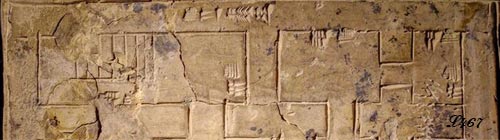
As the scientific discipline of measurement, metrology enabled Mesopotamian architects to leave us plans drawn on clay tablets, providing evidence of their working methods.
These plans reveal the interior dimensions of rooms and the width of openings. Some plans specify the orientation of the buildings relative to the cardinal directions.
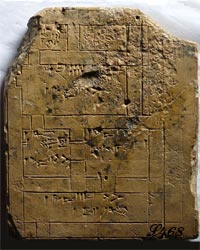
Plan of Girsu, ancient Tello, late 3rd millennium
(Louvre Museum, AO 338).
(Louvre Museum, AO 338).
- Trigonometry :
Following an initial development driven by trade and building construction, mathematics took a new step toward scientific abstraction.
Thus, the Plimpton 322 tablet (circa 1800 BCE), discovered at the site of the ancient city of Larsa, contains lists of numbers that appear to correspond to Pythagorean triples. If this hypothesis were proven true, it would be the first trigonometric table in history, predating the « table of chords » by the Greek astronomer and mathematician Hipparchus (2nd century B.C.) by more than fifteen centuries.
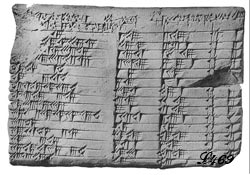
The “Plimpton 322” tablet, dated to 3,700 years ago,
held at Columbia University (New York).
held at Columbia University (New York).
« Abstraction intensifies.
It evolves into languages that elude the uninitiated. »
It evolves into languages that elude the uninitiated. »
- Astronomy :
The approach that first led to astronomy was the observation of the daytime sky. The changing seasons were linked to the Sun’s position in the sky. This science was then enriched by the advent of writing, which made it possible to record unusual celestial phenomena.
The observation of the dance of the night stars, however, was lost when astronomical events came to be interpreted as divine signs.
Thus, in the Babylonian Epic of Creation, the god Marduk assigns a star to each god, and in Mesopotamia, the science of the stars remained confined to astrology.
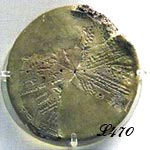
Circular tablet depicting a celestial planisphere indicating the positions of the constellations.
British Museum.
British Museum.
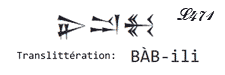
Translation of the text « Gate of the God » in Babylonian cuneiform
(Middle Babylonian, 1600–1000 BCE).
(Middle Babylonian, 1600–1000 BCE).
« By becoming abstract, written language leaves the concrete world
to escape into the magical. »
to escape into the magical. »
« From now on, for humans,
life in society replaces life in the natural world.
Likewise, seeing written signs is enough to perceive real situations. »
life in society replaces life in the natural world.
Likewise, seeing written signs is enough to perceive real situations. »
« Over the course of evolution, hearing had acquired the same function as seeing;
now writing, like cave paintings before it, also allows us to see. »
now writing, like cave paintings before it, also allows us to see. »
- What has the development of writing taught us ? (continued)
Bibliography :