
 |
 |
« Writing is the painting of the voice. »
Voltaire. |
The transition from graphic art to writing
in Egypt and Mesopotamia.
4a – From rock art to writing : the evolution of graphic representation in Egypt :
A - Simplification and dissemination of images :
The Lower Palaeolithic (approximately 800,000 to 300,000 BC).
The Middle Palaeolithic (approximately 300,000 to 40,000 BC).
Upper Palaeolithic (approximately 40,000 to 9,500 BC), figurative art appears.
Mesolithic -9,600.
Neolithic -6,000 Pottery.
Bronze Age -2,300.
Iron Age -800.
Antiquity -50.
Middle Ages 500
Modern era 1500.
Contemporary era 1789.
The Middle Palaeolithic (approximately 300,000 to 40,000 BC).
Upper Palaeolithic (approximately 40,000 to 9,500 BC), figurative art appears.
Mesolithic -9,600.
Neolithic -6,000 Pottery.
Bronze Age -2,300.
Iron Age -800.
Antiquity -50.
Middle Ages 500
Modern era 1500.
Contemporary era 1789.

Petroglyphs and cave paintings perfectly describe the environment and lifestyle of the populations. They even manage to express the emotions of the artists. However, this form of graphic art is too imprecise to convey the knowledge acquired by these populations. At best, the images give us an idea of the local environment, the transition from hunter-gatherer to herder, and the evolution of weapons.
Furthermore, as these images cannot be moved, they remain a source of local information.
In order to achieve writing, a new stage in the evolution of graphic design was necessary..
Thus, in the Neolithic period (-6000 years), the development of agriculture and livestock farming, marked by the sedentarisation of peoples, gave rise to new needs. The emergence of pottery marked a double turning point :
- First, containers protected harvested grains from animals and bad weather. Then, the development of trade made their use indispensable.
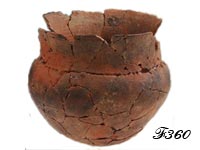
The first ceramics were simple to manufacture : des coils of clay were stacked to form a container.
Appearing around 8000 BC, the use of these containers became widespread around 6000 BC.
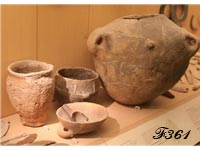
Coil pottery.
- At the same time, communication through graphic design began to evolve. Pottery became a medium for images, whose small size favoured simple designs, an essential transition to the advent of writing.
This is how we find the lines we discovered on the rock walls.
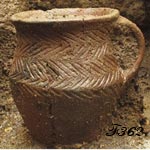
Vase dating from the Early Bronze Age (around 4000 BC),
discovered in a burial site in Le Bono (Morbihan, France).
discovered in a burial site in Le Bono (Morbihan, France).
Le graphisme va peu à peu s’aérer et acquérir sa qualité artistique, tout en conservant sa qualité d’information.
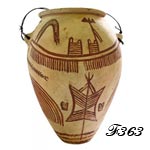
Tomb of the Scorpion King. Nagada III (Egypt)
(Drawing referring to an animal skin stretched over sticks
representing the wrapping of the deceased in a skin -3700 BC).
(Drawing referring to an animal skin stretched over sticks
representing the wrapping of the deceased in a skin -3700 BC).
The shapes traced with lines are filled in.
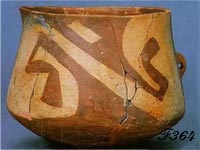
Container found in Hacilar | (Turkey)
The images become more detailed. They evoke reality and take on a narrative aspect.

Neolithic vase from the Indus Valley.
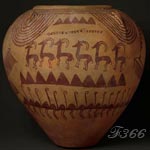
Neolithic vase, Ancient Egypt - Nagada II (3500-3200 BC).
We will see this transition through these mobile media in the series of transformations that will lead to writing in Egypt and Mesopotamia.
B – The transition from images to writing in Egypt :
The Lower Palaeolithic (approximately 800,000 to 300,000 BC).
The Middle Palaeolithic (approximately 300,000 to 40,000 BC).
The Upper Palaeolithic (approximately 40,000 to 9,500 BC), figurative art makes its appearance.
Mesolithic period -9600.
Neolithic period -6000 Pottery.
Bronze Age -2300.
Iron Age -800.
Antiquity -50.
Middle Ages 500.
Modern era 1500.
Contemporary era 1789.
The Middle Palaeolithic (approximately 300,000 to 40,000 BC).
The Upper Palaeolithic (approximately 40,000 to 9,500 BC), figurative art makes its appearance.
Mesolithic period -9600.
Neolithic period -6000 Pottery.
Bronze Age -2300.
Iron Age -800.
Antiquity -50.
Middle Ages 500.
Modern era 1500.
Contemporary era 1789.
The history of writing, from images to graphic symbols, unfolded over thousands of years and differed from region to region : while Egypt and the Middle East gradually assimilated external influences, China retained its ancestral system.
We will now explore the history of this evolution in Egypt, which will allow us to describe all the stages from representation through images to symbolic coding.
During this prehistoric period, five graphic systems succeeded one another.
1 - rock engravings and paintings,
2 - engravings and paintings on vases,
3 - seals,
4 - incisions on containers,
5 - ink stains.
1 - The first graphic system – rock engravings :
These are found on desert rocks (the oldest, in the Aswan region, date back to the Upper Palaeolithic period, around 18 millennia BCE).
Until the end of the 4th millennium BCE, the engraved scenes mainly depict hunting, warfare and funeral rites.
Each scene captures, like a snapshot, the most representative aspect of an event. Even today, they express the experiences of the people of that distant era.
As the precursors of the first Egyptian ideograms, it is likely that each of these petroglyphs already corresponded to a word in the spoken language of these peoples.
For example, engraved depictions of ibises and storks (late 4th millennium) have been discovered in the cliffs of the village of Al-Khawy, south of Luxor.
The cliff of Al Khawy, at the origins of Pharaonic writing.
Egyptian Ministry of Antiquities, Yale University.
Egyptian Ministry of Antiquities, Yale University.
All these images already attest to the evolution of human abilities to communicate life experiences.
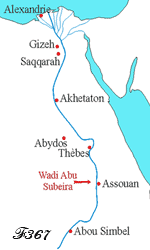
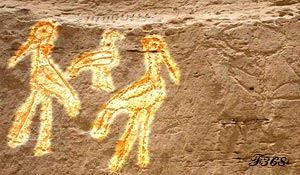
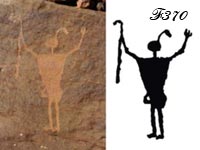
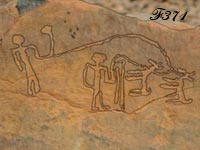
In wadi Abu Subeira (Aswan region), the numerous engravings studied reveal a wealth of information about these herding and hunting peoples.
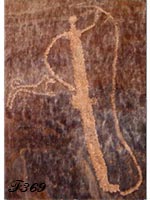
Armed man and dog.
 |
 |
Human silhouettes in Wadi Abu Subeira - Aswan, Egypt (-12,000 to -3,000 years ago)
There is also a group scene where each person is depicted going about their daily activities.
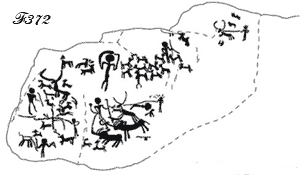
Locus 10
Animals, which were essential to local life, are described in detail.
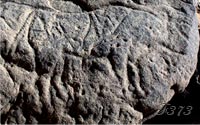
Aurochs in Wadi Abu Subeira (Upper Palaeolithic rock art).
The proximity of the Nile also influences human activities.
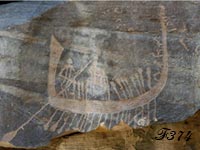
Late Predynastic boat at the CAS-2 site in Wadi Abu Subeira.
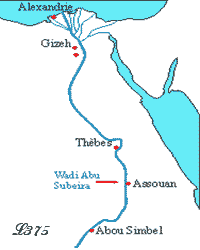
Wadi Abu Subeira.
Later, during the Pharaonic period (-3150), the same routes continued to be dotted with engravings. But they had changed. Instead, there were hieroglyphic inscriptions recounting other activities: military expeditions, trade, or mining.
The proliferation of hieroglyphics reveals the enrichment of spoken vocabulary.

Rock engraving period.
« First stage in the evolution towards writing :
The graphic style of this period, consisting of representative images,
appeals above all to the observer's sensibility and thus marks its universality. »
The graphic style of this period, consisting of representative images,
appeals above all to the observer's sensibility and thus marks its universality. »
2 - The second graphic system :
This consists of various scenes depicted on ceramic vessels (between 3900 and 3350 BC).
Thus, in Egypt, as elsewhere, we see the evolution of graphic design on transportable media.
Until 3700 BC, c-ware (ceramics decorated with white hatching) predominated.
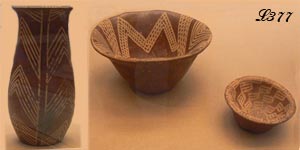
Pottery dating from the pre-dynastic period, 4th millennium BC, British Museum, London.
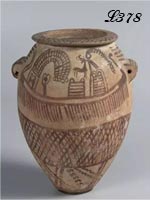
On d-ware (decorated ceramics), the arrangement of the decorations follows other rules of composition.
 |
 |
Jar decorated with a large boat - Louvre AF 6851 - 4th millennium BC Ancient Egypt - Neolithic - Nagada II... |
Ancient Egyptian vase. |
Although schematic, the images are always representative of the lives of these populations : scenes of navigation, animal sequences and rites of regeneration.
Vases were primarily utilitarian, but they provided a mobile medium that promoted both trade and the development of writing.

Pottery era.
Vases painted with complex scenes quickly disappeared, about a century before the advent of writing.
However, before disappearing, these early graphic systems provided syntactic rules for writing. Thus, certain rules used on painted vases can be found in hieroglyphic grammar.
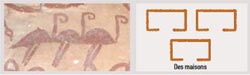
For example, on d-ware as in hieroglyphics, the plural is expressed by the triple repetition of a sign.
3 - The third graphic system :
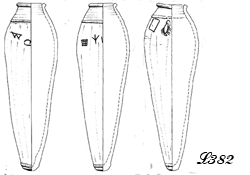
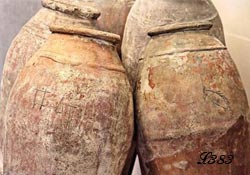
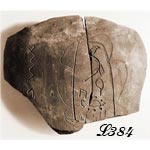
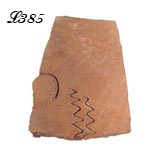
This corresponds to potmarks, marks incised on the outer wall of clay jars before firing.
Potmarks consist of a single sign or a combination of several signs, some of which would later become hieroglyphs.
These marks appeared in Egypt at the beginning of the Neolithic period, became more widespread from 3200 BC onwards, and then disappeared three centuries later.
 |
 |
They were also used for administrative or identification purposes in tombs.
 |
 |
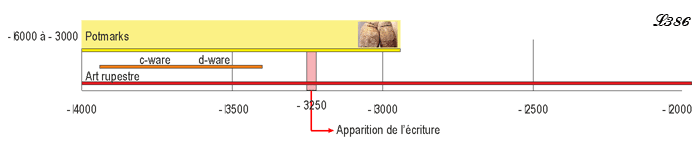
Potmark period.
4 - The fourth graphic system :
Seals first appeared in Mesopotamia. They were then introduced to Egypt at the end of the 4th millennium and were used for 1,000 years as receipts for the transfer of goods travelling long distances.
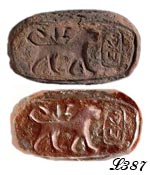
Seal of Pharaoh Amenhotep I.
Small in size and made of stone or ivory, they were used to make an impression on a clay tablet or jar stopper.
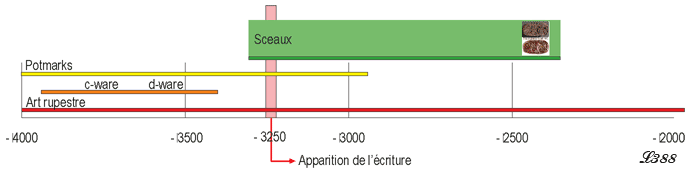
The era of seals.
5 - The fifth graphic system :
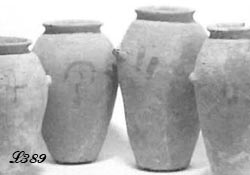
This consists of ink marks decorating jars, most of which were found in tombs, the oldest (-3250) in tomb U-j at Umm el-Qaab (Abydos). This system of annotations remains poorly understood.
 |
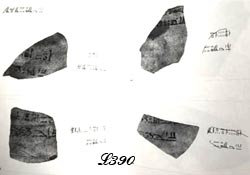 |
Jars marked with ink in the predynastic cemetery U at Umm el-Qaab (Abydos).
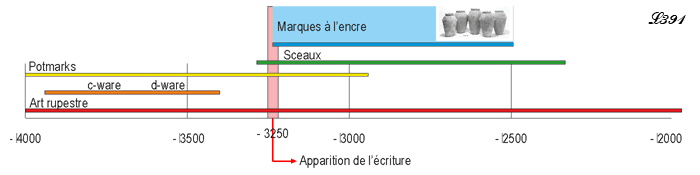
Period of ink marks.
As in rock art, the general evolution of these graphics began with engravings before colours appeared.
« Second stage in the evolution towards writing:
mobile media facilitated the transmission of information. »
mobile media facilitated the transmission of information. »
b – Egyptian writing in the first phase :
This period can be divided into :
- Archaic Egyptian,
- Old Egyptian
- Middle Egyptian
1 - Archaic Egyptian :
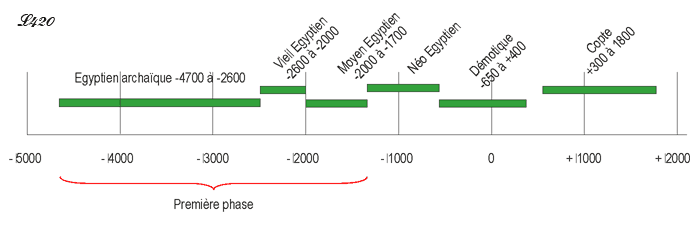
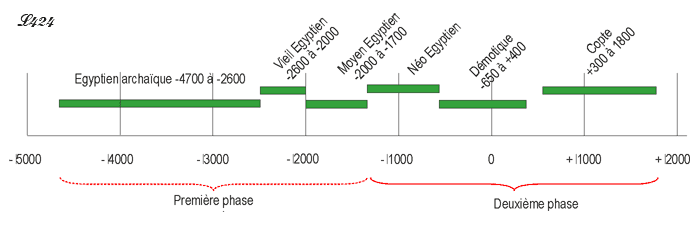
This language was used during the Predynastic Period, the last period of Egyptian prehistory (-4700 -3150).
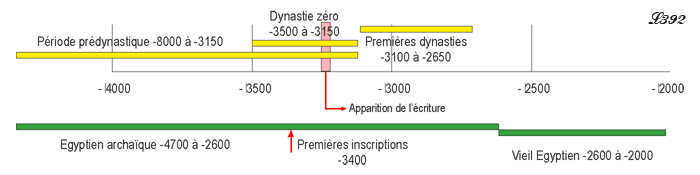
The transformations of the Egyptian language.
The earliest known inscriptions date from 3400 BC. They are found mainly in funerary and administrative contexts. During this period, graphic systems succeeded one another and the first hieroglyphs appeared.
At the end of Egyptian protohistory (Thinite period, around 3000 BC), animals were perceived as beings more powerful than humans.

Battlefield palette. Nagada III.
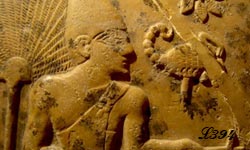
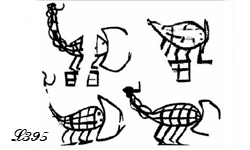
This is undoubtedly why the first kings of ancient Egypt had animal names, such as the Scorpion King, whose mark was found in the tomb of U-j (the necropolis of Umm el-Qa'ab in Abydos mentioned above).
 |
 |
Nevertheless, these systems are considered to be attempts at communication: some were not developed further, while others became sophisticated and effective means of communication.
Although these systems certainly lack the precision of language, they can be seen as the beginnings of writing.
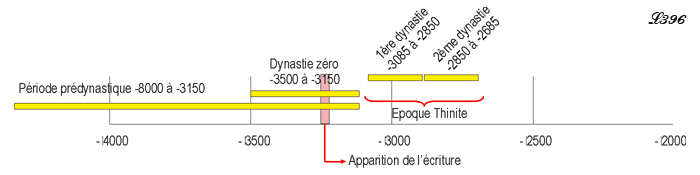
Thinite period.
Towards the end of the 1st Dynasty (between 3000 and 2675 BCE), the Egyptians changed the way they recorded their world : kings abandoned animal names and animal forms became humanised.
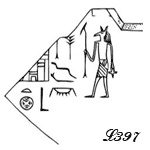
The god Seth on a pottery fragment.
However, even though these hybrid deities only appeared at the end of the Second Dynasty, they are reminiscent of older representations.
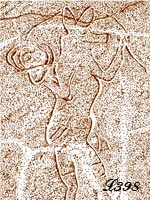
Lycaon-headed therianthrope
carrying an aurochs on his shoulders (Libyan Messak).
carrying an aurochs on his shoulders (Libyan Messak).
Capable of defeating the aurochs and carrying it on his shoulders, man thus asserted his strength. But at the end of Egyptian protohistory, he became aware of his weakness. It was within his extended community and protected by humanised gods that he regained his self-confidence.
Through his new representation of the gods, man showed that he had also become aware of the two aspects of his personality : reason and instinct in its various forms.
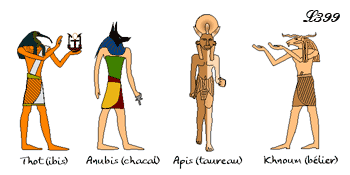
Hybrid gods.
As for the spirits of nature that had settled in the temples (in french), they now found their place in the scriptures.
During this phase, these early hieroglyphs had no proven linguistic function.
2 - Old Egyptian :
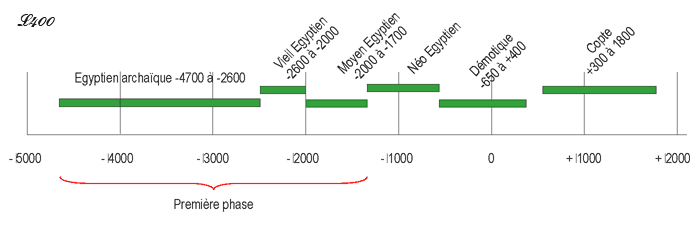
Evolution of the Egyptian language.
Ancient Egyptian is the language spoken during the Old Kingdom (-2700 to -2200) and the First Intermediate Period (-2181 to -2040). Written with hieroglyphs, it underwent several evolutions: phonological, grammatical, and lexical.
- The first hieroglyphs :
Although graphic symbols used to convey information existed long before hieroglyphs, it was not until the end of the 4th millennium BCE that the emergence of a true writing system is attested.
The tomb of Umm el-Qa'ab has yielded a large number of inscriptions dating back to the 4th millennium BC. This is the period when hieroglyphic writing first appeared, on bone and ivory labels or on pottery, each bearing between one and three hieroglyphic signs.
Most of these signs are incised, while others are drawn in black ink.
 |
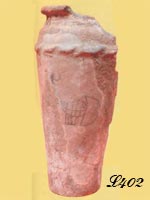 |
Label for an oil jar. |
Jar with one of the oldest hieroglyphic inscriptions. |
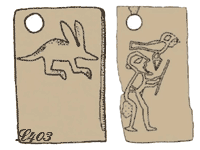
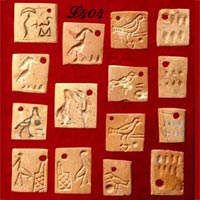
Labels from the tomb of King Scorpion.
The four plates on the right represent, from top to bottom, the numbers: 6, 6, 9 and 8.
The four plates on the right represent, from top to bottom, the numbers: 6, 6, 9 and 8.
« Third stage in the evolution towards writing:
simplification and multiplication of informative signs. »
simplification and multiplication of informative signs. »
In its early days, hieroglyphic writing was limited to areas where the aesthetics and magical value of words were important: offering formulas on funerary steles or coffins, religious texts, and official inscriptions.
These short inscriptions refer to a ruler, a battle, or a quantity. It was around 2700 BCE, during the reign of King Djoser, that constructed sentences began to develop, found mainly in the religious texts of the pyramids.
Gradually, hieroglyphic writing became more complex to allow for the transcription of spoken language: it gradually incorporated phonograms, determinatives and an alphabet.
It was used until Roman times, for over three thousand years.
Pictograms are signs that designate what they represent. They are generally used in contexts where language is a barrier that limits communication.
There are two types of pictograms: logograms and ideograms.
Logograms name the object.
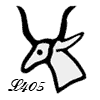
Cow.
They are accompanied by small non-figurative lines to indicate that they are not used for their phonetic meaning.
- Three lines indicate the plural.
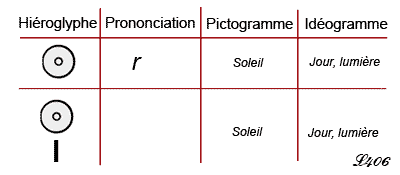
Ideograms are images that indicate an idea or action. They convey their meaning without needing to be pronounced.
They can refer to objects (such as the sun) or abstract concepts (light).

Sun or day, light.
They can also refer to an action, in this case walking.
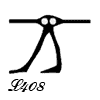
Walking, running, movement.
Phonograms :
Writing began as a representation of beings and things, but symbols could not have designated spoken language if, at the same time, humanity had not managed to isolate sounds in language, assign a graphic symbol to each one, and then organise them using grammar.
Thus, the most important innovation in the development of writing was the acquisition of phonetics (-3100 BC), i.e. the ability to recognise different sounds in vocal expressions and to decide on symbols to transcribe them, as is the case in music.
But before that, images had to evolve and become simpler.
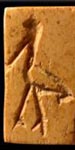
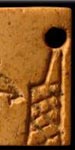
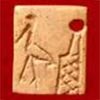
Hundreds of labels found in the tomb U-j give us clues about this evolution.
A petroglyph of a stork mentioned earlier can be found on one of the labels, marking this miniaturisation and the transition from a fixed medium to a mobile medium.
With the advent of phonetics, images transcribed the sounds of language by isolating the syllables of words.
 |
 |
« Fourth stage in the evolution towards writing :
the sounds of speech are represented by hieroglyphic signs,
some signs are assembled in the form of rebuses. »
the sounds of speech are represented by hieroglyphic signs,
some signs are assembled in the form of rebuses. »
Phonograms can represent one, two, or three consonants, as vowels are not recognised.
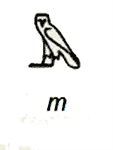
Owl or its ‘m’ sound.
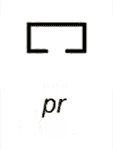
House or its ‘pr’ sound.
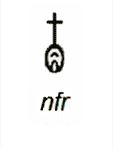
Heart and windpipe or its ‘nfr’ sound.
Déterminatives :
Images and symbols can accurately describe an object or living being, but not an action in progress. This became possible thanks to determinatives, which appeared two centuries later. These complementary signs are not pronounced ; they clarify the meaning of words (object, animal, deity, action, etc.).

Hare or its ‘wn’ sound.
Thus, the image of the hare, which also indicates the sound ‘wn’, takes on a different meaning depending on the sign added.
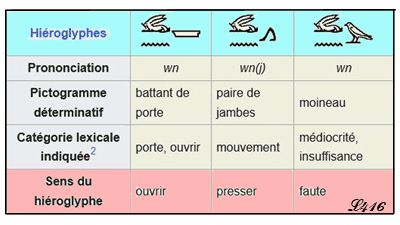
Examples of determinatives that remove ambiguity between identical sounds.
« Each graphic sign can have several meanings.
All describe objects, characters and situations occurring throughout the world. »
All describe objects, characters and situations occurring throughout the world. »
The orientation of the text :
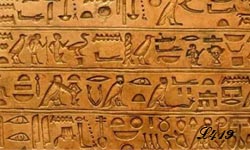
The difficulty of developing hieroglyphic writing necessitated another attempt at organisation, which resulted in linear hieroglyphs.
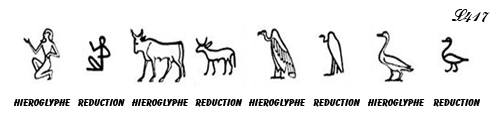
Hieroglyphs and their simplified equivalents.
The simplified hieroglyphs were arranged in either vertical or horizontal lines..
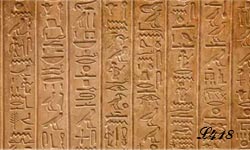 |
 |
« Fifth stage :
The orientation of the signs on lines marks the establishment of a grammar
organising the succession of signs in language. »
The orientation of the signs on lines marks the establishment of a grammar
organising the succession of signs in language. »
3 - Middle Egyptian :
- Hieratic :
This script appeared during the Middle Egyptian period, starting in the Middle Kingdom (2033–1786 BC).
Unlike previous developments, hieratic characters obeyed certain rules : they were now drawn in horizontal lines and read from right to left.
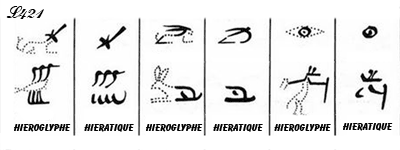
Transformation of hieroglyphic writing into hieratic, according to Champollion.
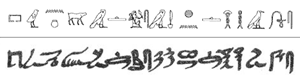
Hieroglyphic characters and their hieratic equivalents.
Hieratic characters no longer represent objects; they are composed solely of abstract signs.
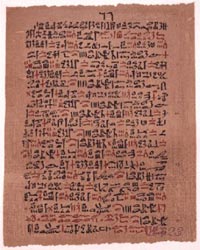
Papyrus Ebers : one of the oldest known medical treatises
written in hieratic (16th century BC).
written in hieratic (16th century BC).
« Sixth stage :
the images disappear, replaced by a style
that facilitates rapid writing. »
the images disappear, replaced by a style
that facilitates rapid writing. »
c – Egyptian writing in the second phase :
Its grammatical structure is more analytical and uses auxiliaries. Articles define the gender of nouns.
An evolution in spelling reflects pronunciation.
Writing developed in the form of religious narratives (The Trial of Horus and Seth) or historical narratives, as well as tales with a mythological background (The Two Brothers).
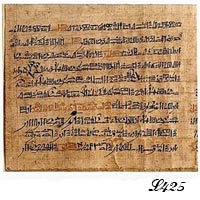
The tale of the two brothers.
Neo-Egyptian, in addition to marking a new stage in the evolution of the Egyptian language, provided a wealth of historical documentation.
- Demotic :
Faced with the sheer volume of texts to be written, scribes gradually developed a new, increasingly simplified form of writing : Demotic (from the Greek ‘demos’, meaning ‘popular’), which was reserved for administrative texts. This form of writing, with its ligatured characters, developed from the 7th century BCE onwards and was used until the 5th century CE. Hieratic was then reserved for religious texts.
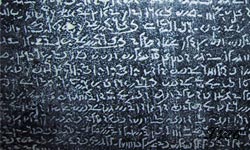
Demotic script.
Rosetta Stone (7th century BC).
Rosetta Stone (7th century BC).
Images were completely abandoned in favour of signs whose letters, linked together, allowed for ever faster writing.
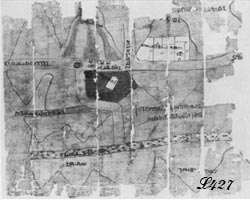
Demotic annotations on a map of a gold mine.
- Coptic :
This is the final evolution of the Egyptian language.
Coptic uses both the Greek alphabet and seven characters from Demotic to indicate sounds unknown to the Greek language.

Coptic alphabet.
In this alphabet, alongside easily recognisable Greek characters, it is possible to trace the origin of characters borrowed from Egyptian writing.
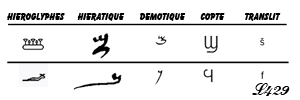
Gradual transformation of hieroglyphics into Demotic.
Most of the words used come from the Egyptian language, with some borrowings from Greek.
Under Greek influence, the direction of writing was reversed from left to right.
Attested as early as the 2nd century during the Roman occupation, and still spoken by peasants in Upper Egypt in the 17th century, this language remains today the liturgical language of the Coptic Church.
« Seventh stage :
The alphabet becomes established. »
The alphabet becomes established. »
« We can see that the history of writing in Egypt
follows the general evolution of graphic design
that prevails among children and has developed throughout the world. »
follows the general evolution of graphic design
that prevails among children and has developed throughout the world. »
«Gradually, images disappear,
and writing now follows an orderly trajectory.
Similarly, humans leave life in the natural environment
to adapt to the rules of life in society.»
and writing now follows an orderly trajectory.
Similarly, humans leave life in the natural environment
to adapt to the rules of life in society.»
C - The transition from images to writing in Mesopotamia : (continued)
Bibliography :