
 |

Chapter 2 - continued
From Images to Writing.
b – Historical period :
- Limited writing systems
- Complete writing systems
- Syllabic systems
- Alphabetic systems
c - Modern times :
d - The 20th century :
e - In summary :

b – Historical period :
The study of languages that exist today, or that past civilisations have bequeathed to us, teaches us how communication through primitive visual signals evolved into the language we use today.
Writing systems can be divided into several groups :
- limited writing systems, consisting of images or "pictograms", constitute the oldest form of writing. Their purpose is to evoke in the mind the image or impression that will subsequently be expressed through language.
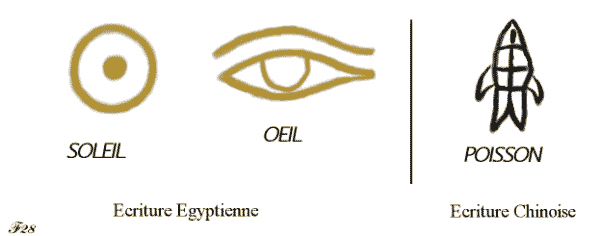
The representative images found in rock art evolved into increasingly abstract forms.
Each word requires a sign.
Each word requires a sign.
- Complete writing systems, on the other hand, are characterised by a correspondence between the signs of the writing system and the spoken language.
As the symbols used no longer merely represent the object referred to, but represent sounds, knowledge of the language is required for comprehension. These are referred to as logograms and phonograms . Egyptian hieroglyphic writing was the first to demonstrate the transition from a logographic system to a phonetic one.
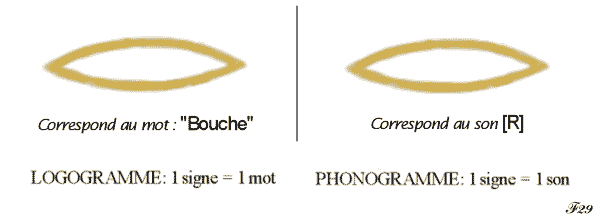
Pictographic writing gradually evolved into phonetic writing.
The number of symbols decreased, but it still required between 500 and 600 signs.
The number of symbols decreased, but it still required between 500 and 600 signs.
In word-based writing systems, a single sign can represent several independent and distinct words. The writing may therefore be ambiguous, but other types of signs are added to resolve the ambiguity.
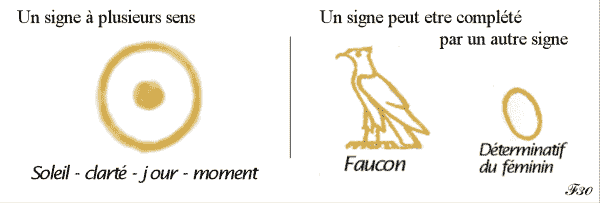
- alphabetic systems : a new milestone was reached when a distinction was made between consonant and vowel sounds ; the number of signs required to represent a word increased, but the total number of signs needed to transcribe the language was very small (20 to 30).
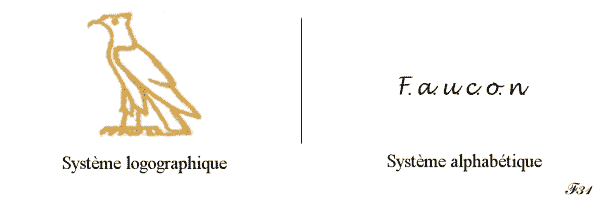
Alphabetic writing represents the final stage of development.
Between 20 and 30 signs, simplified to the extreme, are sufficient to represent all words.
Between 20 and 30 signs, simplified to the extreme, are sufficient to represent all words.
At the same time, the study of languages that exist today has enabled us to understand how the earliest articulated languages, directly derived from animal cries, led to our rich linguistic heritage.
There are currently around 5,000 languages spoken worldwide, constituting a database containing hundreds of thousands of words. However, these very different languages share common words, allowing them to be grouped into families (around 400).
Within these families, researchers have been able to identify other common words, also grouped into families, enabling them to delve ever deeper into what could be a "fossil" language, consisting of just a dozen words spoken around 50,000 years ago (research by Merrit Ruhlen, a linguist at Stanford University, California).
One of these words is ‘tik’ or ‘dike’, which means ‘one’, ‘only’, ‘index’ or ‘finger’...
This gradual narrowing of the lexical field might thus lead us to hypothesise that human language originated from animal cries, but we shall return to this subject in more detail (fig101 - in french).
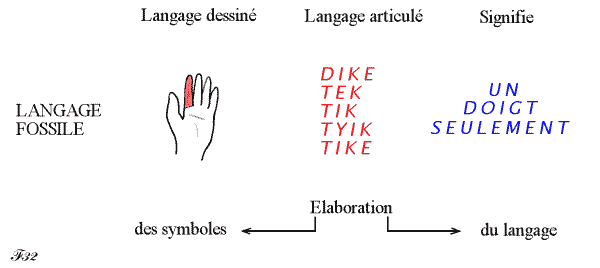
At the same time, the same evolution can be observed within language itself.
It progressed from animal vocalisations to a ‘fossil language’,
before diversifying into the multitude of languages that existed in centuries past.
It progressed from animal vocalisations to a ‘fossil language’,
before diversifying into the multitude of languages that existed in centuries past.
We can therefore observe once again that humankind, even though it has since diverged and followed its own evolutionary path, forms part of the evolutionary continuum of animal species.
In fact, whilst sexual reproduction in primitive plant and animal life favoured the mixing of acquired genetic traits (stored in the DNA molecule), verbal communication favoured the mixing of learnt traits (stored through learning).
However, our aim here is not to study the evolution of languages up to the present day, but quite the opposite: to trace them back to their origins, that is to say, to start with symbolic writing systems and trace them back to the images that gave rise to them.
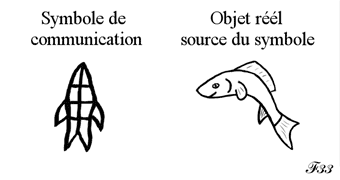
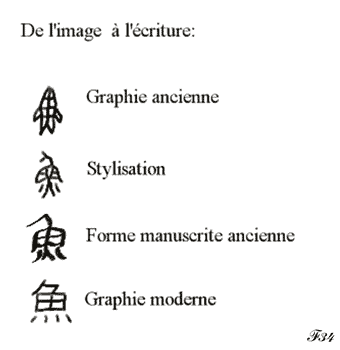
In this return to the origins—which, for us, ends with the pictorial language of dreams—we shall examine the evolution of the Chinese character representing what we write as ‘fish’ in order to trace it back to its origins.
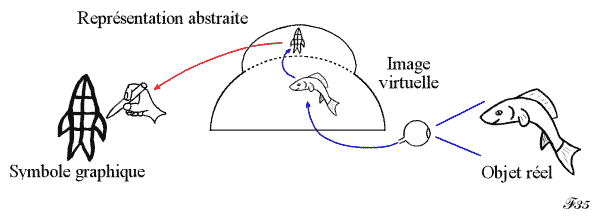
Dreams thus appear to be, within our cerebral structures, the intermediate and decisive stage that enabled us to move from the real object—the fish—to an abstract (graphic) image. They consist of a virtual image, whether static or animated, which forms the basis of the abstract representation drawn before it is transformed within linguistic systems.
We have observed, throughout evolution, that some people retained an almost direct link with nature—even if this link was mediated by the shaman—whilst others gradually lost it. Among the latter, at the very time when the spirits of nature were isolating themselves on Mount Olympus or ‘in heaven’—to be represented only by images—the realms of their abstract thought were becoming dissociated from their ‘animal spirit’.
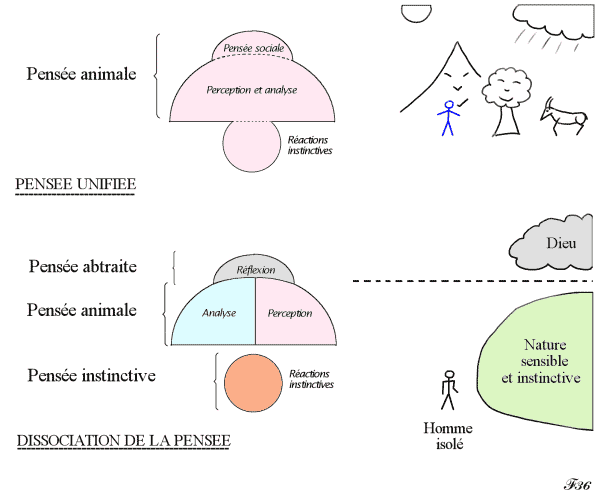
- Animal thought remains a form of thought that is integral to nature.
- Abstract thought is a new form of thought, detached from the natural and concrete world.
- Abstract thought is a new form of thought, detached from the natural and concrete world.
Over the centuries, humankind will continue to develop its abstract language whilst increasingly distancing itself from the natural world. Evolution will take a new turn!
The emergence of animal intelligence goes hand in hand with the creation of language, that is to say, a system of cohesion that enhances adaptation to the environment. Language developed alongside social groups among mammals (such as the sentinel at the edge of the herd). This same language would enable humans to push back the boundaries of their territory by allowing communication to be transmitted across distances, in order to protect themselves from the natural environment and to transform the world according to their needs.
Thus, just as the codes written into the DNA molecule had fixed the characteristics acquired within living organisms, written texts would fix the characteristics learnt by humankind.
But these early spoken and written languages, which forged links between people, were, at that time, still capable of communicating directly with nature, whether with nature spirits or with God the Creator.
c - Modern times :
Human societies will extend beyond the limits of sound and light signals; telecommunications and energy transmission networks will emerge.
We have observed that animals themselves have developed a nervous system that provides them with information about their entire organic territory and about events occurring at the boundaries of that territory.
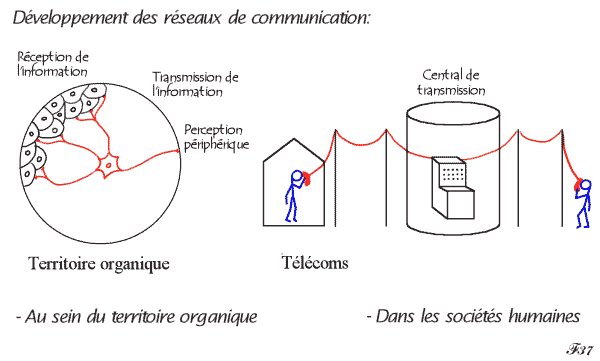
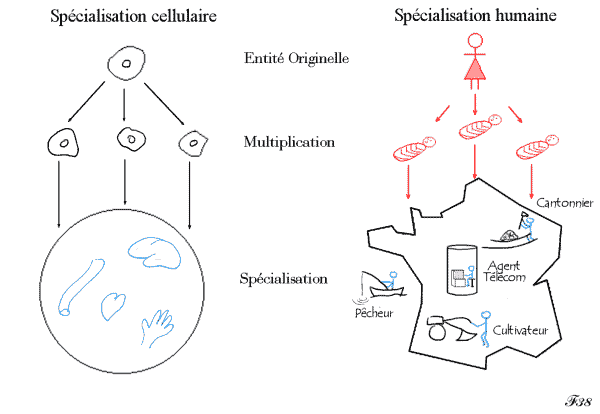
Every person connected to the whole of the human community has, like the cell and early humans, every possibility of transforming themselves; yet they retain only a part of this capacity and specialise to meet their own needs and those of society.
A new stage has been reached : man definitively turns his back on the sensible world to devote himself to his materialist reason. He questions this world, which has itself become material, and attempts to understand it whilst striving to recreate it.
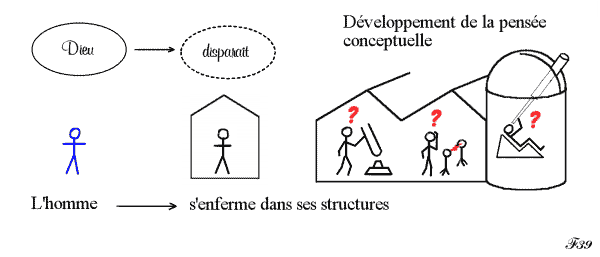
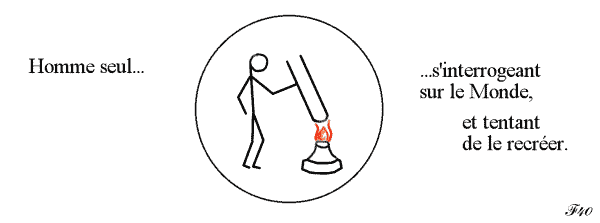
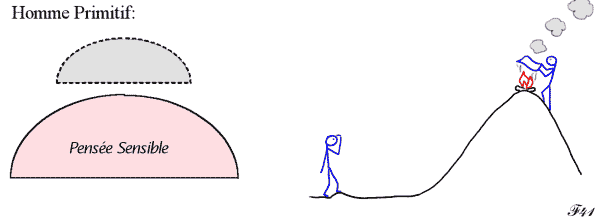
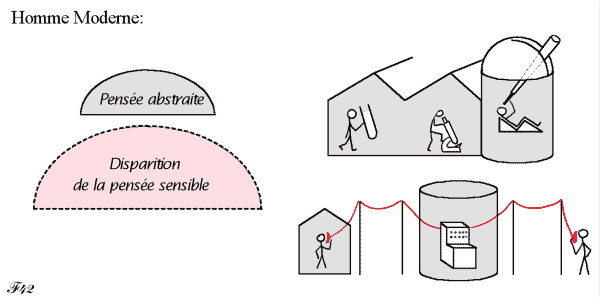
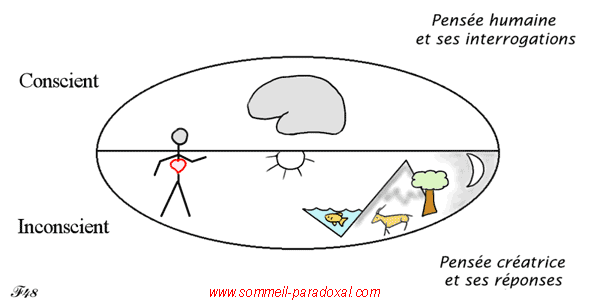
At the beginning of this century, a turning point in thought occurred. Suddenly, man no longer projected his spiritual quest towards the heavens, or his inner wealth elsewhere; instead, psychology reminded him of a path that leads through the self.
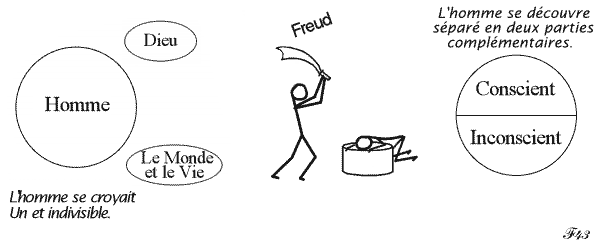
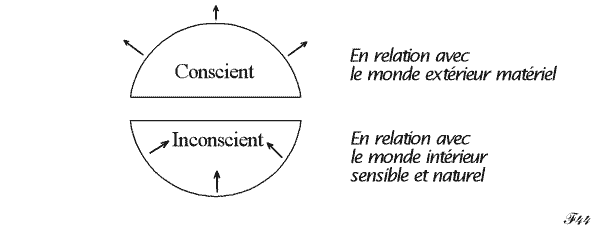
But these two isolated parts hold within them the potential for another capacity: that of reuniting...
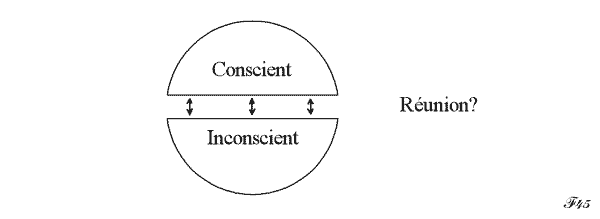
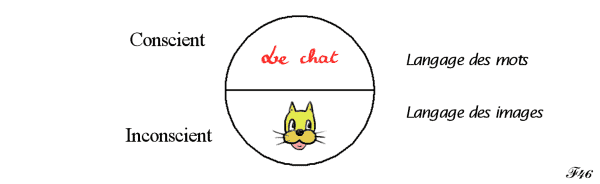
- verbal language.
- and the imagery of dreams.
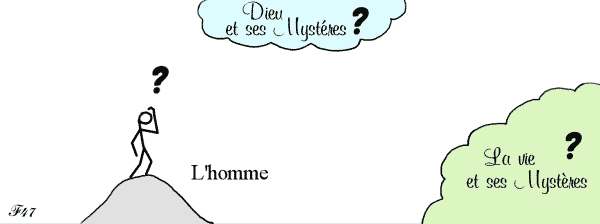
- on the one hand, humankind and its questions.
- on the other, God, the creator of life.
- and, on the sidelines, life itself.
And this unconscious possesses its own form of thought : the natural thought of dreams !
1 – The development of life forms that facilitate communication :
Chemical and acoustic communication :
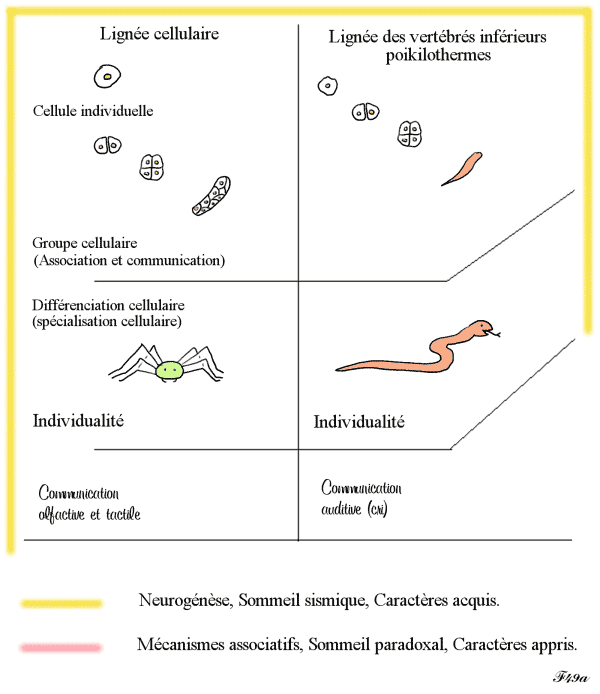
Communication, which was initially chemical amongst the earliest cells, evolved towards vibrational perception.
Vocalisations and language :
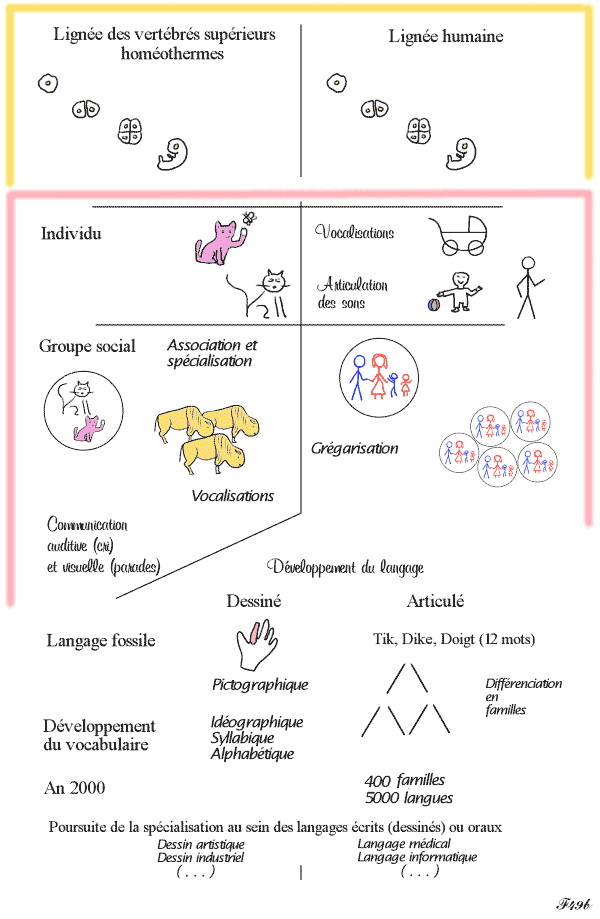
This vibrational perception then evolved into vocalisations, ultimately leading to complex language.
2 - The evolution of communication within societies :
Visual and auditory language :
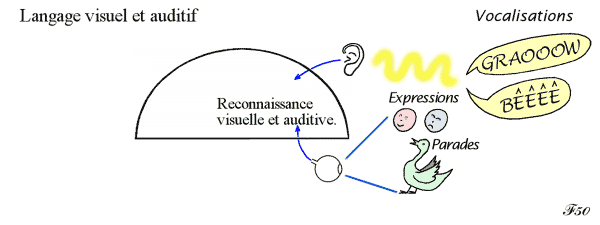
The emergence of sight and hearing :
animals recognise their environment.
animals recognise their environment.
First representations of images :
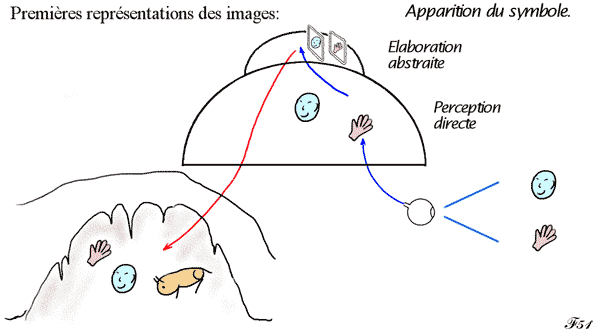
A new stage is reached in evolution : early humans manage to represent in two dimensions
a world that appears to them in three dimensions. This is the visual symbol.
a world that appears to them in three dimensions. This is the visual symbol.
The emergence of language :
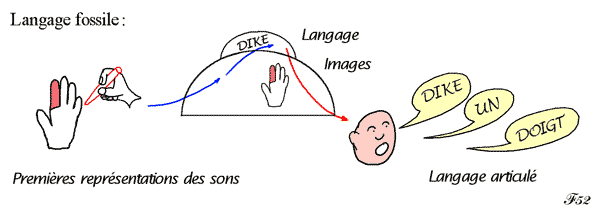
The visual symbol takes on a new dimension by acquiring the ability to express a sound.
The development of language and writing :
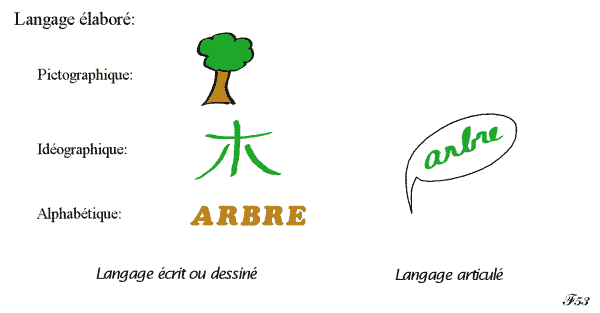
Starting with spoken communication, which mirrors what the eye perceives (the tree),
written language develops, gradually evolving from the image of the object to a stylised image,
ultimately leading to the abstract symbol (alphabetic writing).
written language develops, gradually evolving from the image of the object to a stylised image,
ultimately leading to the abstract symbol (alphabetic writing).
Chapter 3 - The neural basis of thought (in french)