
 |

Chapter 2
The Guidelines of Evolution.
1 - The emergence and development of thought within life :
A - Interactions within matter :
B - The emergence and evolution of life :
a - The emergence of the cell :
b - The emergence of the cellular territory :
c - The emergence of the animal :
- The development of the reptilian brain :
- The emergence of the social brain :
- Animal language :
2 - Development and evolution of human thought :
A - Development of social structure :
B - Adaptation of thought and communication to social structure :
a - Prehistoric period :
- Primitive auditory and visual language :
- Symbolic language of images and sounds :
b – Historical period :

1 - The emergence and development of thought within life :
To understand dreams, we must seek to understand the mechanisms through which life evolved to bring about the development of an essential characteristic of living beings, known as "intelligence", which subsequently became human intelligence as this evolution continued.
A - Interactions within matter :
Matter gave rise to life through a fundamental mechanism: an interaction between its primordial elements, which combine to create various components capable of variation.It is as though, from the very beginning, since the universe was made up of atoms and energy, none of these elements could remain isolated and, as they encountered one another, they combined and separated to create more complex molecules…
The means of communication enabling interactions between these elements was therefore "energy".
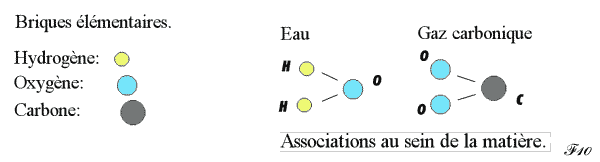
Within matter, elementary particles combine to form molecules.
B - The emergence and evolution of life :
A turning point in the evolution of matter occurred when carbon-based elements formed molecules that were more fragile but capable of evolving more rapidly, which would go on to form the foundations of living organisms as we know them.a - The emergence of the cell :
At present, it is impossible to understand and explain the why and how of this evolution; only so-called "evolutionary" theories enable us to grasp that, in the history of the universe, a continuity can be observed in the evolution of organic life right up to the present day, without being able to determine whether this evolution is due to chance or "intended" by a force that is beyond our comprehension.
In any case, for modern humans to exist, it is inevitable that ‘chance’ must have followed a necessary course, without which life would not be what it has become.
The "chances" of evolution thus enabled the emergence of the first organic molecules, then the first living organisms ; finally, natural selection came into play, favouring viable biological forms whilst ruthlessly eliminating the ‘failures’. The first form of memory, embedding the conditions for failure or success within matter, appeared with the DNA molecule.
Once the first biological cell had demonstrated, through its survival, the validity of these mechanisms—which were, once again, based on chemical interactions or communications between these various elements—other factors came into play to promote survival.
Random processes, which favoured the development of the earliest forms of life, were succeeded by the cell itself initiating mechanisms to adapt to the outside world.
Strength in unity ! ...
Chance ? A glimmer of intelligence ? Who can say ?
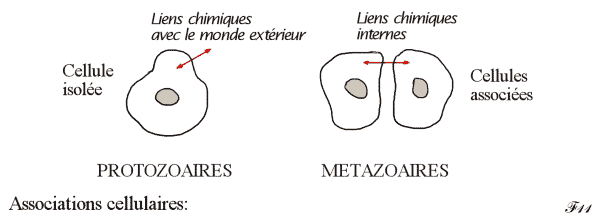
Within the living world, cells come together to form organisms.
But one day, cells come together to form cellular organisms...
- Chemical bonds :b - Emergence of the cellular territory :
To ensure their cohesion, multicellular organisms create molecular bonds that enable them to develop a form, a territory, which the entire cellular society will occupy.
The animalcule and its body succeed the cell and, within this body, chemical bonds of communication are formed.
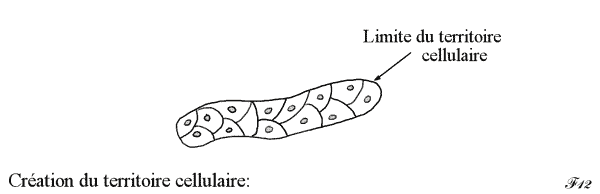
Organisms develop within a defined territory...
The animal progresses from the protozoan stage to the metazoan stage.
At a certain stage in the development of this bodily territory, the biological mass ceases to grow, as the chemical resources sufficient for a ‘cellular village’ prove inadequate at the level of a ‘cellular nation’.
So the cells begin to specialise :
- into ‘hunter’ cells, which draw from the outside world the elements necessary for survival.
- into ‘restorer’ cells, which transform non-assimilable elements into elements usable by the cellular society.
- then ‘road-maintaining’ cells establish communication routes to transport the assimilable elements from one end of the territory to the other.
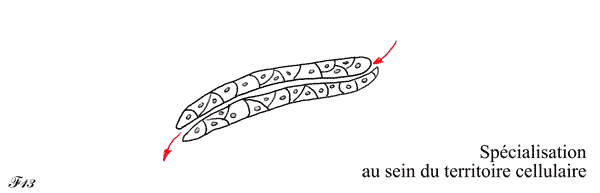
...and, within this territory, the cells begin to specialise.
Each cell now contributes to both its own survival and that of the organic territory, but its individual life has become dependent on the group as a whole.
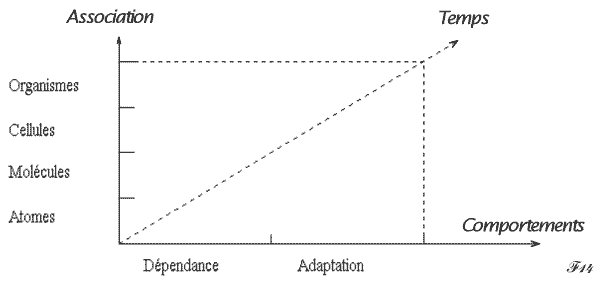
This development into organisms facilitates adaptations to the environment.
- Emergence of the nerve cell :
What had previously been sufficient to sustain the territory’s vegetative life now proves insufficient to react quickly to stimuli from the outside world : survival is once again at stake.
A new, faster information system became necessary : ‘telecommunications’ emerged, in the form of nerve cells sending out their extensions to the periphery of the territory in order to inform the entire cellular population in real time of the immediate environmental conditions.
All the cells in the organism then have access to information about conditions in the external environment without any direct link to that external world.
A certain form of intelligence emerges : the animal can finally "understand" its environment and adapt very quickly to circumstances. The entire organism, receiving information in real time, first coordinates its internal response, and then its response to the outside world, once new "locomotion" specialists appear (muscle cells, technical cells specialising in joint mechanics).
This intelligence is then essentially reflexive in nature and adapted to the immediate environment: the first sense , that of touch, emerges, soon to be joined by the other four – taste, sight, hearing and smell.
- Development of the reptilian brain :c - The emergence of the animal :
But the barely mobile micro-organism is still too at the mercy of its environment, and too small to survive an attack by a larger predator. The animal yet to come is underpinned by this adaptation, which is still too fragile and too archaic : the path outlined will continue, leading to the point where we stand today.
In the meantime, the cell has acquired, within its central nucleus, a "school" that accumulates and imparts knowledge, enabling it to apply this knowledge in life. The DNA molecule contains this individual and collective memory, which the cell will draw upon to specialise within the organism.
The small, ill-defined territory sees its boundaries take on more distinct forms and its biological mass grow.
Cold-blooded animals – first insects, then reptiles – will evolve, incorporating an autonomic nervous system for nutrition and a locomotor system governed by a primitive brain known as the"reptilian brain".
The animal is now equipped with a nerve centre, the ‘brain’, capable of memorising events and responding to its environment through instinctive, genetically determined reactions: survival requires an internalisation of the external world, and this takes place within the reptilian brain. The information reaching the brain originates from the body’s periphery to provide details of immediate contacts, whilst the eye and vision, the ear and hearing also emerge to provide information about distant surroundings.
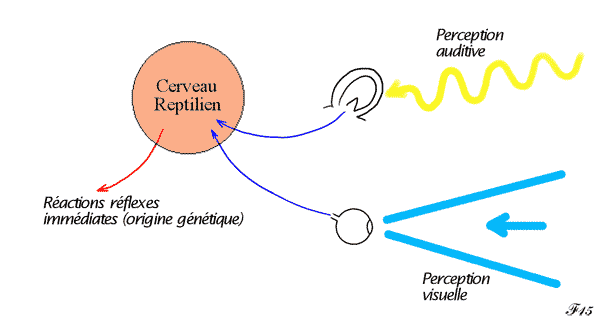
The primitive brain is essentially geared towards individual survival and is characterised by its capacity for reaction.
- The emergence of the social brain :
A new stage, arising from life’s previous experiences, then takes shape. Life has learnt that the isolated cell is vulnerable and that there is strength in numbers ; it will use this past experience to continue its evolution.
Gregarious behaviour emerges and, alongside the pack instinct, a social brain begins to develop.
Animals no longer abandon their eggs or young once the reproductive cycle is over. The family emerges, followed later by the social tribe, with new specialisations: the sentinel, stationed at the edge of a larger territory, is tasked with warning the group.
A new form of communication then develops : language integrates the raw vibrational information perceptible to all living beings (sounds, light) into a system where vibration can be modulated (calls) and visual appearance altered (gestures).
Mammals, even more so than reptiles, would go further in memorising life events. This memorisation became both individual and social: parents taught their young; the young, once grown, also incorporated the experience of the social group, which was enriched by the knowledge of each individual.
Memory is no longer merely individual, but becomes collective, integrating the raw information of reflexive genetic life (the reptilian brain) into two more evolved cerebral systems: the right hemisphere, the seat of emotions, and the left hemisphere, the seat of logic.
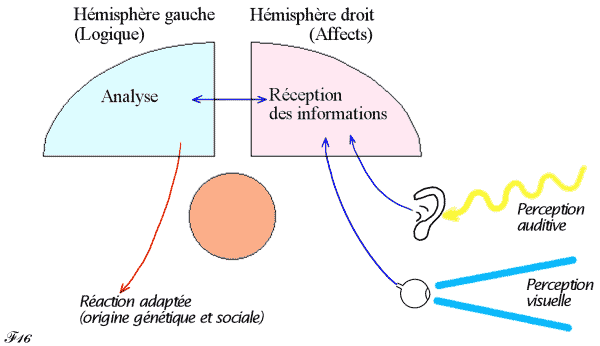
In social animals, cellular development and specialisation continue within the brain :
new structures emerge to filter out purely instinctive reactions.
new structures emerge to filter out purely instinctive reactions.
- The animal’s language :
Animal evolution is complete, encompassing inner life, outer life, the sensitivity to perceive the outer and inner worlds, the logic to react to perception, and language to communicate.
At this stage, language does not exist in the form we are familiar with: words do not yet replace raw vision, hearing or smell.
There is as yet no ‘reflection’ on events, that is to say, perception, the synthesis of these events into sentences, followed by reasoning based on those sentences...
There is only the engagement of the senses with a view to an appropriate reaction.
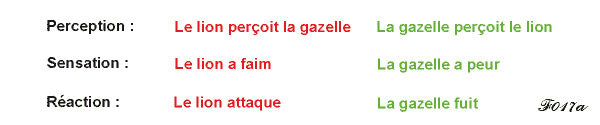
Recognition itself incorporates :
- the environment,
- the intruder (within that environment),
- facial expressions and gestures (of the intruder),
- and their cry (the only form of language at that time, a modulated vibratory complement to the wave-like perception of gestures).
2 - The development and evolution of human thought .
A - The development of social structure :
Life seems to have invented nothing new since the dawn of time : it is always the same mechanism of association that prevails, whether it be that which governs the association of atoms into molecules, the association of molecules into cells, the association of cells into organisms or, in the case of humans, the association of individuals into ever-larger groups.If we take as our starting point the idea put forward by certain creation myths, such as the myth of Adam and Eve, we might imagine that in the very beginning there was only a solitary individual who one day found a partner to form the first couple : Adam and Eve. This couple had children : the family was born. Then the children, as with primitive animals, left their parents and became isolated individuals once more, only to one day meet their ‘soulmate’ in order to perpetuate the species… The family was, at that stage, merely a transitional state.
But we can also imagine that the hostility of the surrounding world forced the family to remain united, joining forces with other families to form the tribe.
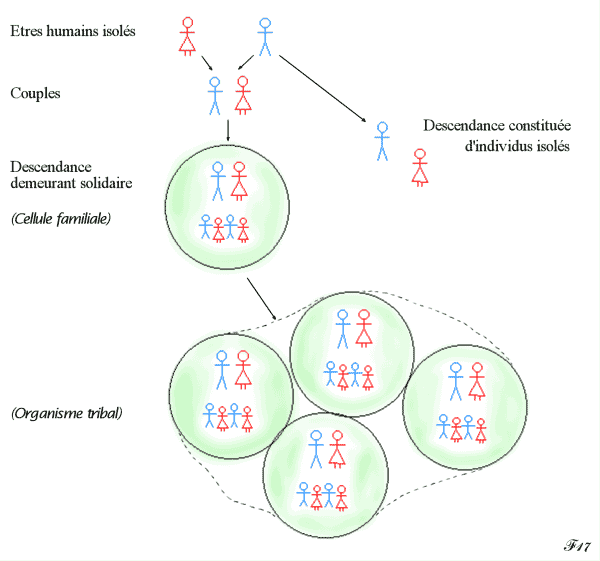
Human beings follow the same pattern of evolution as atoms and cells.
They progress from the isolated individual to the individual who is part of a group.
They progress from the isolated individual to the individual who is part of a group.
Just as certain animal societies claim a territory, humans would do the same, creating a tribal territory with clearly defined boundaries, adjoining the territories of other tribes, and their patterns of thought and communication would follow the same course of development.
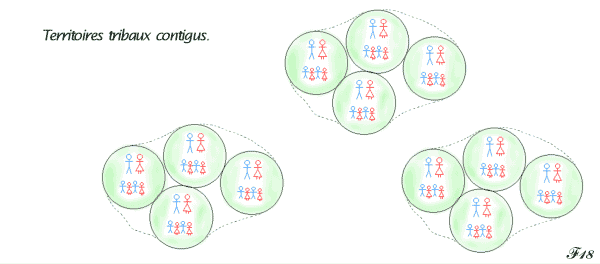
As the group grew, it would split up and occupy a larger territory.
This increased distance would necessitate a new adaptation: language would have to overcome the barrier of distance.
This increased distance would necessitate a new adaptation: language would have to overcome the barrier of distance.
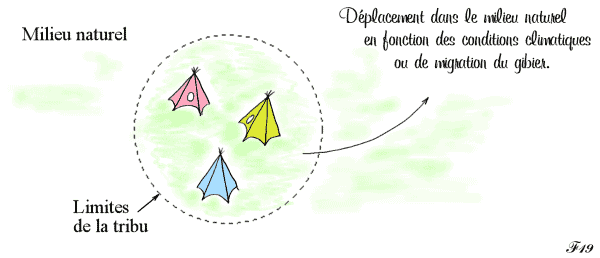
At the same time, climatic conditions or the need for hunting grounds will lead humans to adopt the same behaviours as animals, in particular the migratory behaviour we call nomadism.
B - Adaptation of thought and communication to social structure :
a - Prehistoric period :- Primitive auditory and visual language :
Evolutionary theories have enabled us to better understand the mechanisms behind the emergence of intelligence and its evolution within living matter and the animal world, from the origins of life to the present day. Today, discoveries in biology , de la zoology , the human sciences and neuroscience have clarified this continuity.
In the early days of humankind, at a time when humans had not yet become separated from their natural environment, we can assume that their nervous systems were not very different from those of animals.
The language of humans in those distant times, derived from the modulated language of the most highly evolved animals, had not yet developed its own grammatical rules.
This language was essentially represented through imagery, as demonstrated by cave art.
At this tribal stage, behavioural language facilitated interactions between members of the tribe, as can be observed in animal societies: language did not yet need to be elaborate, since the perception of the external world was sufficient to adjust one’s behaviour. This visual communication, observable in all higher vertebrates (courtship displays), developed in humans with the development of facial mobility and expressive abilities (facial expressions).
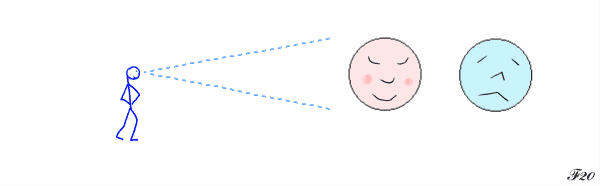
The first form of communication was visual communication.
Within a group that maintained its cohesion, this system alone could facilitate communication within the family or nomadic tribal structure.
In the case of humankind, it was when nomadic tribes began to settle down and then establish themselves over larger territories that, as distances increased, the need arose for more sophisticated communication systems enabling the environment to be perceived from greater distances: optical systems (smoke signals) and acoustic systems (drums). As we have seen, this stage may correspond, in the cellular organism, to the physical and chemical links between cells (hormones diffusing throughout the organism) and between the cells and the outside world.
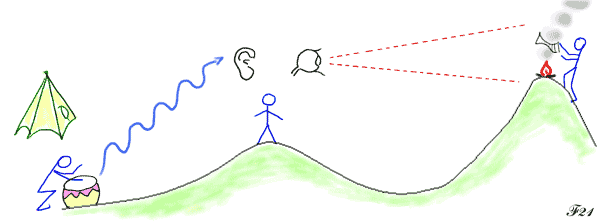
Whilst sufficient for close-range communication, this form of communication would need to be refined in order to overcome distances.
Acoustic and visual signals would acquire the capacity for language.
Acoustic and visual signals would acquire the capacity for language.
But which came first, the chicken or the egg : did territory create the conditions for a more elaborate language, or did a more elaborate language make it possible to overcome distances ?
Apparently, as is always the case, both mechanisms certainly developed at the same time.
- The symbolic language of images and sounds :
This is the period for which we have painted or engraved records. It reflects the emergence of a new form of abstraction in humans, who record events on an external medium : this is written memory, which has become the complement provided by evolution to genetic memory.
The humanities have taught us that early humans relied primarily on visual representations of the world.
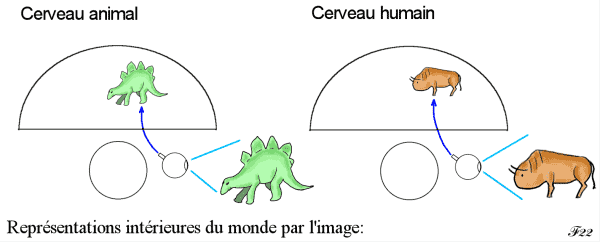
The brain, capable of forming an internal representation of the external world...
Prehistoric humans therefore, like all animals, used these internal representations, but on this occasion their brains had just taken the first step towards "abstraction" : their minds had become capable of recreating the real world on the walls of a cave. The first virtual world has just emerged: the brain can, after perceiving the outside world (1) and reconstructing it within its mental structures (2), represent it in two dimensions (3).
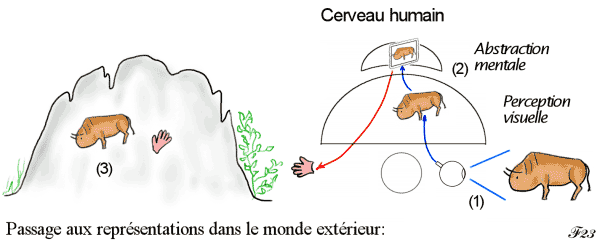
...will become capable of transcribing this inner vision into images.
Whilst the family unit, consisting of members very close to one another, did not need these mental aids to survive when hunting and fishing, the tribe—that is, the association of several families sharing out tasks—required the establishment of this new system.
Thus, the tribe organises itself. Each member (hunter, fisherman) carries out a specific activity to provide for the needs of the group, which becomes a social entity independent of the outside world. However, by using the outside world solely to meet his needs, man gradually loses touch with it...
Animals have retained the ability to perceive directly and intuitively how they should behave in response to environmental conditions.
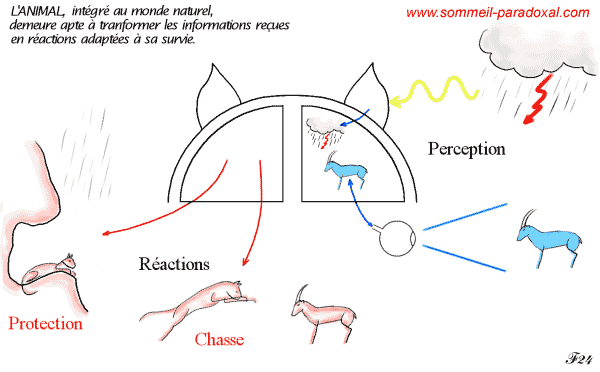
This is where humans differ from animals !
Animals remain capable of reacting based on the information they perceive...
Animals remain capable of reacting based on the information they perceive...
Humans, by specialising, lose this connection ; just as modern humans, who have learnt about electronics, forget how a seed grows. Having become hunters or fishers, they no longer obey their individual needs as animals do, but those of the social group.
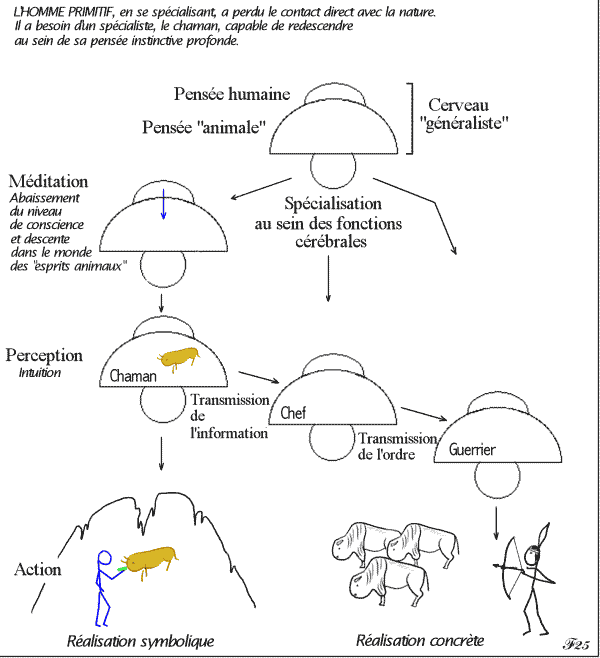
...humans, for their part, lose this ability as they develop other skills useful to the group.
Only the shaman remains capable of perceiving the natural world.
Only the shaman remains capable of perceiving the natural world.
Thus, by detaching himself from the world, man has lost the animal’s natural integration with the world, and only a member of the tribe retains the ability to understand the natural world.
This "specialist"is the shaman or sorcerer, who, through his goal-oriented daily thoughts, is able to rediscover the animal within his deepest being – the animal capable of perceiving and feeling the world, and of reacting in accordance with the environment …
The man capable of speaking with the ‘animal spirits’ becomes able to ‘know’ why the game has disappeared, and where it may have gone in search of other grazing grounds…
This period marks the emergence of the first painted or engraved depictions of real-life events, the first written language and, in this sense, the first human memory capable of being passed on to future generations. However, this language remains, nonetheless, a visual language.
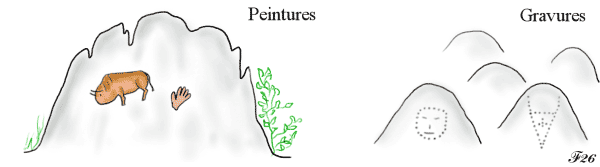
The emergence of the first painted or engraved depictions constitutes the first visual language.
The first symbols representing life emerged : what remained was to develop this visual language into a fully-fledged means of communication, based on symbolic images, evolving in parallel with body language and facial expressions, which retained their role as a form of instant communication.
This evolution of humankind reveals, within its mental structures, the emergence of a new module. Capable of abstraction, this module would create an unprecedented system enabling humankind to describe its perceptions and communicate them over a distance.
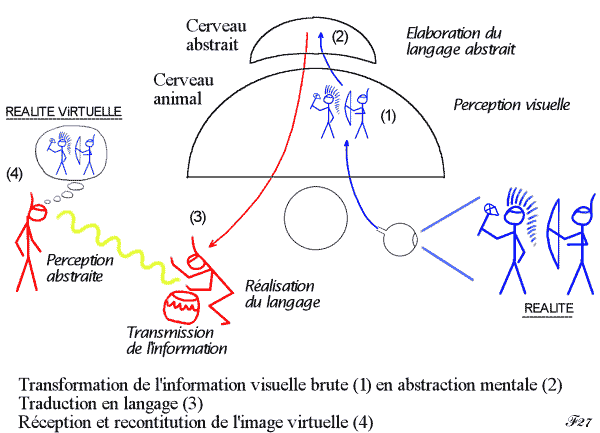
Humankind would acquire a new mental structure, "abstracted" from the natural world.
This structure will enable him to transcend the constraints of distance and time..
This structure will enable him to transcend the constraints of distance and time..
This new abstract language has the advantage of being perfectly suited to the life of the individual or the group.
b – Historical period : (in french)