Evolution
of communication .
Interactions between bacteria : Bacteria share resistance genes remotely.
A new mode of antibiotic resistance transfer between bacteria has just been discovered. Using innovative microscopy techniques, scientists were able to film DNA transfer between physically distant cells in real time. The hypothesis that this gene transfer requires direct contact was therefore false.
Science & Avenir-La Recherche N°923 Janvier 2024
A phoneme is the smallest unit of sound in the spoken chain, capable of producing a change in meaning by switching (e.g. lamp/ramp).
https://ww2.ac-poitiers.fr/dsden16-pedagogie/IMG/pdf/graphemes_phonemes_def_liste_frequence.pdf
A study conducted in April 2011 enabled Dr Quentin Atkinson (University of Auckland) to trace the origins of human language to Africa. To achieve this, he catalogued and compared the number and diversity of phonemes in 504 languages around the world.
The languages with the richest diversity of phonemes were found in Africa, mainly along a coastal strip stretching from Senegal to South Africa. Conversely, the least rich languages are found in Oceania and North America, which are the continents most recently occupied by humans.
However, this research was challenged in 2012.
Homo sapiens :
The oldest known fossils of this species, discovered in Morocco at the Djebel Irhoud site, date back approximately 300,000 years.
hhttps://fr.wikipedia.org/wiki/Homo_sapiens
Homo habilis : (literally ‘skilful man’) is an extinct species of the genus Homo which, according to fossils found to date, is believed to have lived in East Africa between approximately 2.3 and 1.5 million years ago.
https://fr.wikipedia.org/wiki/Homo_habilis
Homo erectus : (literally ‘upright man’) is an extinct species of the genus Homo.
There is no consensus among scientists as to the definition of Homo erectus. Researchers have three main theories regarding this name.
- According to the first, Homo erectus corresponds to most of the African and Asian fossils known for around 2 million years, which are more or less intermediate in form between Homo habilis and Homo heidelbergensis.
- A second school of thought considers Homo ergaster and Homo georgicus, and even Homo gautengensis, to be valid names representing human forms older than Homo erectus. The scope of this latter designation would then only include African fossils dating from approximately 1.5 million to 700,000 years ago and most Asian fossils older than 400,000 years.
- For a third school of thought, Asian fossils should be classified in their own group, under the name Homo erectus.
https://fr.wikipedia.org/wiki/Homo_erectus
Broca and Wernicke : Broca's area is one of the two main areas of the hominid brain responsible for language processing. Discovered by French physician Paul Broca in 1861, it is located in the cerebral cortex at the lower part of the third frontal convolution of the dominant hemisphere (usually on the left side, in both right-handed and left-handed individuals). It corresponds to Brodmann areas 44 and 45.
Broca's area is the area associated with the production of spoken words, while Wernicke's area is associated with the comprehension of these words. However, other areas associated with language have been identified, and language processing functions are more widely distributed across all these areas.
https://fr.wikipedia.org/wiki/Aire_de_Broca
Descent of the larynx : According to an article discussing the work of some twenty researchers, the position of the larynx is of little importance for the formation of vowels that are sufficiently differentiated to enable speech. ‘What matters is not so much the size of our vocal tract, which starts at the vocal cords and goes up through the pharynx to the mouth, but how we modify it through the movements of the lips, jaw or tongue,’ explains Louis-Jean Boë. According to this researcher, not only is a low larynx not necessary for speech, but monkeys and babies are also perfectly capable of producing distinct sounds..
https://lejournal.cnrs.fr/articles/depuis-quand-parlons-nous
Neanderthal man : The oldest Neanderthal fossils recognised as such are those from Sima de los Huesos, dating back 430,000 years.
https://fr.wikipedia.org/wiki/Homme_de_N%C3%A9andertal
Hyoid bone : The hyoid bone is a bone located above the larynx, in the front of the neck, below the base of the tongue. It is unique in humans in that it is the only bone in the skeleton that is not articulated with another bone.
https://fr.wikipedia.org/wiki/Os_hyo%C3%AFde
Campbell's monkey is a species of tree-dwelling monkey.
In December 2009, a study conducted by ethologists at Taï National Park in Côte d'Ivoire revealed that male Campbell's monkeys emit six different types of alarm calls, which they combine to form long vocal sequences of 25 successive calls on average. These sequences allow them to vocally communicate information about their social life and various dangers. In particular, the timing of responses is reminiscent of human conversation. This is the most complex form of proto-syntax discovered in a non-human species.
https://fr.wikipedia.org/wiki/Mone_de_Campbell
https://www.science-et-vie.com/article-magazine/langage-des-singes-relancent-le-debat-sur-son-origine
https://lejournal.cnrs.fr/articles/culture-et-communication-chez-les-singes
Man's place in evolution : By placing himself at the top of the evolutionary pyramid, man has ignored or forgotten that he is on the same evolutionary level as all other living beings today.
How, then, can we understand the differences that exist between species? Quite simply, our world contains an infinite number of ‘life niches’ with vastly different conditions, and each species has adapted to a particular niche.
Thus, at any given moment, and in a particular environmental setting, all living beings possess the highest level of adaptation.
If we observe the evolution of species, the appearance of humans is not an end point, in which case they would be the only ones to survive, but a different adaptation made possible by their ability to move around and protect themselves within this environment (clothing, huts, etc.).
Thus, all living species, at a given time, have the optimum adaptation: only the environmental conditions change (surface of the ground, subsoil, humidity, drought, northern hemisphere, southern hemisphere, day, night, etc.).
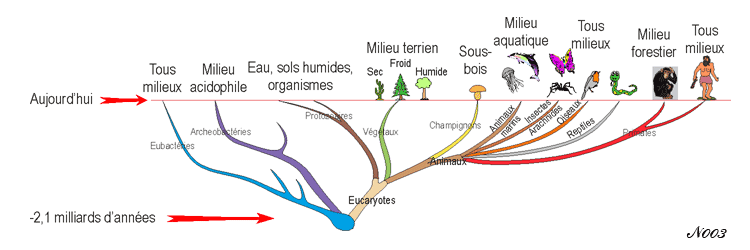
from the cell to the organism, the adaptation of living beings to their environment.
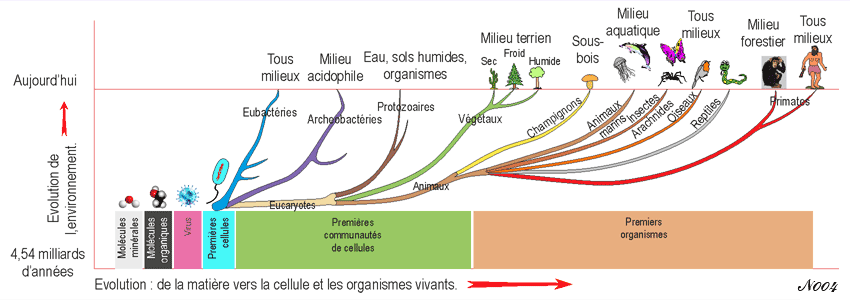
from the molecule to the organism, the evolution of matter to the living beings of today.
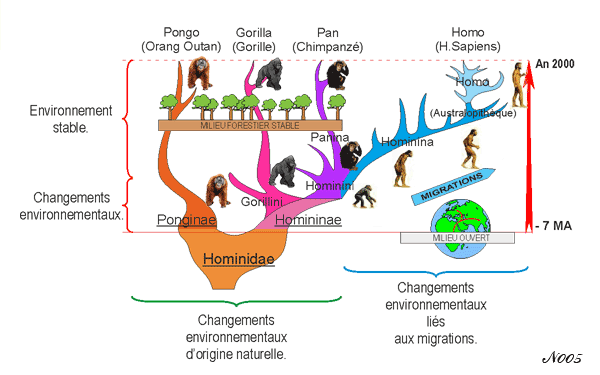
For example, most paleoanthropologists believe that the divergence between Hominina (the human lineage) and Panina (the chimpanzee lineage) occurred at least 7 million years ago. This raises the question of what environmental conditions may have changed during this period. Since chimpanzees remained in a forest environment, we could deduce that migration determined the evolution of Hominini into Hominina and then Homo.
In Gabon, Abderrazak El Albani's team discovered fossil remains of an impressive variety of complex colonial organisms, the oldest documented to date, in sediments dating back 2.1 billion years.
https://www.science-et-vie.com/article-magazine/il-nous-faut-savoir-tout-ce-qui-sest-passe-depuis-le-commencement
Quentin Atkinson : heads the Language Cognition and Culture Lab, whose interdisciplinary research draws on psychology, evolutionary biology, linguistics,
In an article published in Science, Atkinson shows that by applying mathematical methods used in genetics to linguistic data from 504 languages around the world, it is possible to trace the origin of language to West Africa.
https://www.languagesoftheworld.info/historical-linguistics/atkinsons-theory-of-language-origins.html
Phylogeny : Phylogeny is the study of the relationships between living and extinct organisms :
- between individuals,
- between populations,
- between species.
It allows us to reconstruct the evolution of living organisms
https://fr.wikipedia.org/wiki/Phylog%C3%A9nie
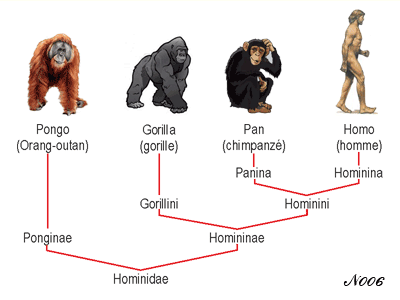
Hominidae : are a family of simian primates that includes the current genera Pongo (orangutan), Gorilla (gorilla), Pan (chimpanzee) and Homo.
https://fr.wikipedia.org/wiki/Hominidae
Homininae : are a subfamily of simian primates belonging to the Hominidae family. This subfamily includes Euro-African hominoids, namely the Gorillini (gorillas) and Hominini (representatives of the Homo genus and chimpanzees) tribes.
https://fr.wikipedia.org/wiki/Homininae
Feral child : The term feral child refers to a child who has grown up outside or on the margins of human society.
https://fr.wikipedia.org/wiki/Enfant_sauvage
Voice articulation : Vowels are throat sounds. These are the sounds made by animals.
Control of the tongue allows for the articulation of certain letters, such as ‘L’, and control of lip movement allows for plosive letters such as “P” and ‘B’.
FOXP2 :The Forkhead-Box P2 protein was first discovered in 1998 in a study of a London family, many of whose members had severe speech difficulties. Since then, FOXP2 has been recognised as playing a major role in language transmission, including grammatical abilities.
Apart from bats, this protein differs very little in mammals and other vertebrates such as songbirds, fish and reptiles.
https://fr.wikipedia.org/wiki/Prot%C3%A9ine_Forkhead-P2
Like humans, songbirds learn to sing by imitating the songs of their elders. These birds are therefore able to modify their innate vocalisations to copy or create new sounds.
Parallels have thus been drawn between human speech and birdsong, in addition to similarities in the brain circuits involved in learning and producing sounds.
https://www.ipubli.inserm.fr/bitstream/handle/10608/6304/MS_2008_11_906.html
Prosody : (Le Robert Dictionary) Prosody refers to the duration, melody and rhythm of the sounds in a sentence (or poem), as well as the rules that govern them.
1. The set of rules relating to the quantity, or duration, of vowels and syllables in Greek and Latin poetry;
2. Linguistics : The study of the elements that contribute to the pronunciation of words and sentences, without reference to phonetics. Prosody is particularly concerned with the duration and intensity of sounds.
https://www.dictionnaire-academie.fr/article/A9P4680
Affective prosody : Melody of language (Mounier-Kühn): all the modifications of the voice (intonation, sound accentuation, tempo, pauses) that reinforce the content of speech, mainly in terms of its affective colouring.
https://www.psychologies.com/Dico-Psycho/Prosodie
Ventriloquist :
A person who can articulate without moving their lips, using a voice that seems to come from the stomach; in particular, an artist who performs with a puppet and uses this technique to give the impression that the voice is coming from the puppet's mouth.
https://www.cnrtl.fr/definition/ventriloque
One of the difficulties of the exercise lies in the fact that labials (B, P, M) and fricatives (F, V) cannot be articulated. Practising ventriloquism requires training in order to master the facial muscles and lips, tongue and compensate for their absence by adapting the vocal cords of the tongue.
https://fr.wikipedia.org/wiki/Ventriloque
Voir aussi : https://www.unil.ch/sli/fr/home/menuinst/ressources/cours-et-livres-en-ligne/cours-de-phonetique-en-ligne/introduction.html
Example of sign language used by deaf people after learning it : voir https://www.college-saint-cyprien.fr/vie-de-letablissement-2/langue-des-signes-2/
However, this learned language is very different from the one that develops spontaneously among deaf people.
Biface : A biface is a carved stone tool that first appeared in the Lower Palaeolithic period in East Africa and spread to Europe and Asia during this period.
The Lower Palaeolithic is the first period of prehistory, which began 3.3 million years ago with the appearance of the first stone tools, or 2.8 million years ago with the first fossil attributed to the genus Homo in Africa. It ended around 300,000 years ago with the appearance of new stone tools.
https://fr.wikipedia.org/wiki/Biface
Great clockmaker : Of all the philosophers of the Enlightenment, Voltaire (1694-1778) remains a reference point. He occupies a special place in a philosophical movement that questioned the foundations of political systems, particularly in the Kingdom of France, devoting his writings and interventions to the service of freedom of thought, belief, tolerance and justice.
Unlike many of the philosophers of the Enlightenment, he was not an atheist and expressed this in his cabals :
« The universe confuses me, and I cannot imagine
That this clock exists and has no clockmaker. »
On the other hand, Voltaire was a fierce opponent of religious fanaticism and intolerance, denouncing superstitions that distance man from reason.
https://www.assistancescolaire.com/eleve/4e/histoire/reviser-une-notion/voltaire-philosophe-des-lumieres-4_his_03
https://fr.wikisource.org/wiki/Page:Voltaire_-_%C5%92uvres_compl%C3%A8tes_Garnier_tome10.djvu/192
2 – Verbal language and writing :
Incommensurable : Of such considerable extent or magnitude that it cannot be measured. (Dic.Larousse).
Disinformation : The development of artificial intelligence, via the Midjourney website, has made it possible to disseminate a multitude of completely fake “period photos” that are difficult to identify. They are regularly found in fake news, whether for humorous, commercial, or outright disinformation purposes.
For example, in 1950, scientists allegedly discovered structures at the South Pole revealing the past presence of an unknown civilization. In 1957, the first furry convention was held—a movement of animal costume enthusiasts—and in 1962, British chemist Rosalind Franklin allegedly won the Nobel Prize in Medicine for her discovery of DNA.
Although documented by “period” photographs, these events never took place. All of these images were created in 2023 by artificial intelligence (AI) image generators.
https://www.lemonde.fr/les-decodeurs/article/2023/05/11/les-images-creees-par-ia-et-le-risque-de-reecrire-l-histoire_6172920_4355770.html
Midjourney is an example of generative artificial intelligence capable of converting natural language text into images. Midjourney can create convincing images from a simple textual description. In some cases, Midjourney's images have been able to fool photography experts !
https://midjourney.co/fr
See also :
"Story Killers" : an investigation by 100 journalists reveals the scale of the disinformation industry.
Radio France's investigative unit spent several months working alongside 30 international media outlets as part of the ‘Story Killers’ project, coordinated by Forbidden Stories. It lifts the veil on the behind-the-scenes workings of the rapidly growing disinformation industry
https://www.francetvinfo.fr/monde/story-killers/
https://www.francetvinfo.fr/monde/story-killers-une-enquete-de-100-journalistes-revele-l-ampleur-de-l-industrie-de-la-desinformation_5658659.html
https://www.francetvinfo.fr/vrai-ou-fake/vrai-ou-fake-comment-la-propagation-de-la-desinformation-s-est-acceleree-en-france-au-cours-des-dernieres-annees_5737643.html
Derek Bickerton : Derek Bickerton (1926–2018) was a linguist and professor at the University of Hawaii in Honolulu. He studied Creole languages in Guyana (formerly British Guiana) and Hawaii. He concluded that the process of creolisation can help us understand language acquisition in children and the evolution of language ability in humans.
https://fr.wikipedia.org/wiki/Derek_Bickerton
To support the idea of a proto-language, he drew on four types of arguments.
– The study of sign language that experimenters were able to teach to great apes.
– The language of two-year-old children.
– The language of little Genie [see below], an American child who was sequestered at birth and kept in isolation for years.
– The study of pidgins, languages spoken by populations of different nationalities forced to live together, as was the case with African slaves on cotton plantations.
Cahiers Science et Vie N°118 :
Génie : is the pseudonym of a feral child born on 18 April 1957 and discovered in Los Angeles on 4 November 1970, after years of abuse, neglect and social isolation.
Although unable to master language, she was not mentally retarded and, on the contrary, was brilliant at non-verbal communication. With a few strokes on a piece of paper, she could illustrate complex ideas and even feelings. Her ability to understand and reason logically was also intact.
Despite this, she was unable to master the basics of language: while she was very skilled at tasks using the right hemisphere of the brain, she failed at those using the left hemisphere.
https://fr.wikipedia.org/wiki/Genie
Pidgin et créole : A Pidgin language is ‘a simplified language used for communication between people who speak different languages.’
This language incorporates words from different languages, as well as a new common vocabulary. It is used as a second language, with speakers retaining their native language.
Gradually, Pidgin languages evolve into Creole languages, most often when they become the common language after the speakers' original languages have disappeared.
Creoles that evolve from pidgins acquire more complex grammatical structures and a more extensive vocabulary.
https://hispanic-net.org/fr/langages-pidgin-l%C3%A9volution-et-les-exemples-dun-langage-pidgin/
https://fr.wikipedia.org/wiki/Pidgin
Hominina : This term encompasses all species of the human lineage that separated from the chimpanzee lineage (Panina) 6 to 7 million years ago. The most notable characteristic recognised in Hominina is bipedalism, whereas chimpanzees and gorillas are quadrupeds.
https://fr.wikipedia.org/wiki/Hominina
Cercopithecidae : This term refers to a monkey with a long tail.
https://fr.wikipedia.org/wiki/Cercopith%C3%A8que#D%C3%A9finition_du_terme
Ecological niche : The ecological niche corresponds to :
- the place occupied by any living being in an ecosystem,
- the conditions necessary for its survival.
https://www.techno-science.net/glossaire-definition/Niche-ecologique.html
Hawaï : This main island of an archipelago of 137 islands has an area of 10,435 km², equivalent to the size of Lebanon.
Africa is a continent with an area of 30,415,873 km². It covers 6% of the Earth's surface and 20% of the land surface.
https://fr.wikipedia.org/wiki/Hawa%C3%AF_(%C3%AEle)
https://fr.wikipedia.org/wiki/Afrique
Cochlea :This spiral-shaped part of the inner ear is approximately 10 millimetres wide. It is essential for transducing different sound frequencies.
The cochlea is divided into three fluid-filled chambers. Two of these detect pressure changes caused by sound, while the third chamber contains the organ of Corti. The organ of Corti consists of three elements: hair cells, the cochlear duct and the basilar membrane.
http://www.cochlea.eu/cochlee/organe-de-corti
At birth, we have approximately 12,000 hair cells. Hair cells can be damaged and lost throughout our lives due to loud noises or other conditions. Once lost, these cells do not regenerate.
https://fmedic.org/lanatomie-de-la-cochlee
Positional numbering system : C’est un système de numération dans lequel un chiffre représente des valeurs différentes selon la position qu’il occupe dans un nombre.
Ainsi, dans le système de numération décimal, le chiffre 8 occupe la position des dizaines dans le nombre 285, et la position des centaines dans le nombre 1825.
https://lexique.netmath.ca/systeme-de-numeration-positionnel/
Sexagesimal system : The sexagesimal system is a number system using base 60.
Unlike most other number systems, the sexagesimal system is not used in computing or pure logic.
It is mainly used for measuring angles and geographical coordinates, expressed in degrees (60 minutes = 1 degree), (60 seconds = 1 minute) or for measuring time (60 seconds = 1 minute: 60 minutes = 1 hour).
https://fr.wikipedia.org/wiki/Syst%C3%A8me_sexag%C3%A9simal
Calendar calculation : (CNTRL) all calculations aimed at establishing the calendar of movable feasts.
Natural language : A natural language, or ordinary language, is a ‘normal’ language, i.e. one spoken by human beings. It contrasts with formal languages (such as computer languages) and constructed languages.
https://fr.wikipedia.org/wiki/Langage_naturel#cite_note-GDT-1
Language structure : When, in the 1960s, linguist Noam Chomsky postulated the existence of a universal grammar, he was not referring to the grammar taught in schools, but to the code used to translate ideas into sequences of words.
These codes are said to be respected by all 6,000 languages listed in the world. Proponents of innateness (what is innate) seek to identify rules common to different languages.
Our brain has the ability to forge an unlimited number of semantically and grammatically correct combinations from a limited number of words. According to the linguist, this can only be explained if it is programmed to do so.
(voir Science et Vie numéro 990)
Espace-temps :The space-time continuum, a central concept in Einstein's theory of relativity, merges the three spatial dimensions with time into a four-dimensional fabric. This merger fundamentally changes our understanding of the universe and directly influences our perception of reality.
Initially formulated by Albert Einstein as part of his theory of relativity, this concept has transformed our understanding of the universe.
This theory also has a significant impact on practical technologies, including GPS systems for accurate positioning and navigation, as well as astrophysics for determining celestial trajectories.
https://www.science-et-vie.com/ciel-et-espace/quest-ce-que-le-continuum-espace-temps-122925.html
3 – The evolution of communication through graphic design :
Francesco d’Errico :
Francesco d’Errico is a CNRS research director at the PACEA laboratory (From Prehistory to the Present: Culture, Environment, Anthropology – CNRS, University of Bordeaux, and Ministry of Culture and Communication) and professor at the Center for Early Sapiens Behavior at the University of Bergen, Norway.
https://www.u-bordeaux.fr/universite/espace-presse/repertoire-dexperts/francesco-d-errico
Pensée symbolique :
Symbolic thinking allows us to talk about what happened in the past and imagine what might happen in the future. In other words, it allows us to step outside the current situation and evoke another reality.
https://nospensees.fr/quest-ce-que-la-pensee-symbolique/
In his book The Psychology of Intelligence, developmental psychologist Jean Piaget defines symbolic thinking as the representation of reality through the use of abstract concepts.
Symbolic thinking refers to the ability to represent people, objects and events, even those that are not present, through the use of symbols or internal images.
It is necessary for child development, as it helps children understand the most abstract concepts. Symbolic thinking allows us to talk about what happened in the past and imagine what might happen in the future. In other words, it allows us to step outside the current situation and evoke another reality.
https://etreparents.com/quest-ce-que-la-pensee-symbolique/
Random access memory :
Random access memory, sometimes abbreviated to RAM, is the computer memory in which information can be stored.
The characteristics of this memory are:
Direct access to information,
Fast access, which is essential for quickly providing data to the processor,
Volatility, which causes all data in memory to be lost as soon as the power supply is cut off.
https://fr.wikipedia.org/wiki/M%C3%A9moire_vive
Read-only memory :
The term read-only memory (ROM) refers to a non-volatile computer memory whose contents are fixed and can be read multiple times by the user but cannot be modified.
https://fr.wikipedia.org/wiki/M%C3%A9moire_morte
Cave and rock art :
In the context of the study of prehistoric art, “parietal art” (from the Latin parietalis, “relating to walls” in the sense of rock faces) refers to all works of art (without aesthetic appreciation) created by humans on the walls of caves and rock shelters. Most authors today distinguish it from rock art (from the Latin rupes, “rock”), art on rocks in the open air, but also from portable art (which can be moved).
https://fr.wikipedia.org/wiki/Art_pari%C3%A9tal
Scientific theories :
- Art for art's sake according to the materialist school,
- Art as a recourse to totemism,
- Art as a ritual of magical hunting,
- Art as a shamanic ritual,
- The structuralist approach,
- Art linked to regional myths,
- Art as a form of proto-writing,
- The utilitarian conception, which assumes that rock art representations reflect functional concerns.
Georges-Henri Luquet :
Born in 1876 and died in 1965, he was a French philosopher, a student of Bergson and Lucien Lévy-Bruhl at the École Normale Supérieure, an ethnographer and a pioneer in the study of children's drawings.
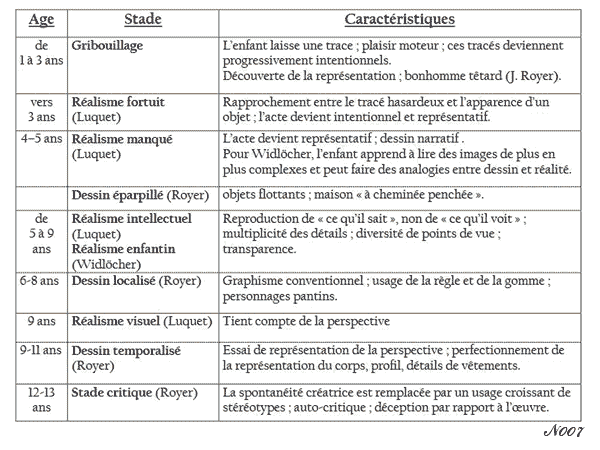
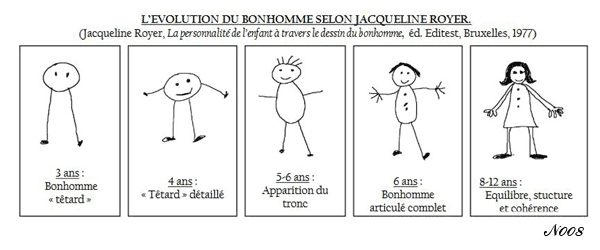
Originally, in 1926, the stick figure test was invented by psychologist and teacher Florence Goodnough to assess the development of intelligence in children. Although it is still sometimes used to measure intelligence, this practice is now criticised because it reduces intelligence to certain abilities and does not take into account the diversity of cognitive skills.
In 1977, the work of Jacqueline Royer, a doctor of psychology who views drawing as a language, provided tools for analysing and interpreting the test as a means of understanding personality.
Nowadays, the stick figure test is mainly used as a projective personality test because it draws on the imagination and reveals hidden aspects of personality.
Bifaces :
The oldest bifaces currently known in the world were unearthed by Hélène Roche's Franco-American team on the shores of Lake Turkana in northern Kenya. They date back 1.76 million years and mark the beginning of the Acheulean, a culture that would evolve over nearly 1.5 million years, spreading throughout Africa and a significant part of Eurasia.
https://www.inrap.fr/magazine/Dernieres-nouvelles-de-la-Prehistoire/Culture-materielle/il-etait-une-fois-le-biface-en-europe
Stone Age :
The Stone Age is the period of prehistory that began in the Lower Palaeolithic and during which humans made and used stone tools and weapons.
It is the longest period of prehistory, beginning 3.3 million years ago and ending between 3000 and 2000 BC.
This period is subdivided into:
- Lower Palaeolithic (approximately 800,000 to 300,000 BC)
- Middle Palaeolithic (approximately 300,000 to 40,000 BC)
- Upper Palaeolithic (approximately 40,000 to 9,500 BC): emergence of figurative art.
- Mesolithic: 9,600 to 6,000 BC
- Neolithic: 6,000 to 2,300 BC: Pottery
https://fr.wikipedia.org/wiki/%C3%82ge_de_la_pierre
Petroglyph :
A petroglyph (from the ancient Greek pétros, meaning ‘stone’, and gluphḗ, meaning ‘engraving’) is a symbolic or representative drawing engraved on a natural rock surface. It is a form of rock art.
Cup mark :
In archaeology, a cup mark is a petroglyph consisting of a circular or oval depression carved by humans into the surface of a natural rock, megalithic slab or cave wall.
https://fr.wikipedia.org/wiki/Cupule_(arch%C3%A9ologie)
Cognition :
Cognition is the set of mental processes related to the function of knowledge and involving memory, language, reasoning, learning, intelligence, problem solving, decision making, perception, and attention.
https://fr.wikipedia.org/wiki/Cognition
Mousterian :
The Mousterian is a prehistoric stone tool industry belonging to the Middle Palaeolithic period.
Children's drawings :
It could be argued that Neanderthal drawing techniques bear no resemblance to those used by children, which would rule out any possible comparison. Children use modern, easy-to-handle tools, whereas Palaeolithic adults worked stone using primitive tools.
However, children without pencils will use any malleable medium, just like primitive humans without tools: sand, dust, condensation on cold windows or jam on the table.
Paréidolia :
A psychological phenomenon whereby a vague or ambiguous stimulus is interpreted as a familiar shape in various contexts (clouds, constellations, etc.).
https://www.lalanguefrancaise.com/dictionnaire/definition/pareidolie
https://www.lalanguefrancaise.com/dictionnaire/definition/pareidolie
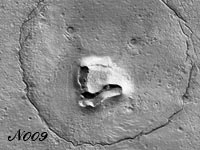
Photo taken by NASA, the American space agency, on 12 December 2022. (UARIZONA / JPL-CALTECH / NASA)
These optical illusions are common when looking at celestial bodies or everyday objects. They can be explained by our brain's natural tendency to make sense of random shapes.
NASA has published a photo of the surface of Mars showing a geological formation resembling a bear's head. Of course, it is neither an engraving, a sculpture, nor a geoglyph like the famous Nazca lines in Peru. According to scientists at the American space agency, what looks like a snout is actually a ‘collapsed hill’ or a hill that was torn apart after a ‘volcanic event’ that caused ‘mud or lava flows’. . What many people see as eyes are in fact ‘two craters’. As for the circle that outlines the head, it is a ‘circular fracture’ also marked by a deposit of lava or mud.
https://www.francetvinfo.fr/sciences/espace/trois-questions-sur-la-pareidolie-cette-capacite-de-notre-cerveau-a-voir-une-tete-d-ours-sur-la-planete-mars_5634263.html
Sistrum :
The sistrum is a musical instrument belonging to the percussion family and the idiophone subfamily. It usually consists of a frame onto which fruit shells, seashells or metal discs are strung, which strike each other when played.
https://fr.wikipedia.org/wiki/Sistre
Glyphe :
in archaeology, this refers to an engraved line.
https://dictionnaire.lerobert.com/definition/glyphe
https://dictionnaire.lerobert.com/definition/glyphe
Neandertal :
Neanderthal man (Homo neanderthalensis), or Neanderthal, is an extinct species of the genus Homo, which lived in Europe, the Middle East and Central Asia until around 30,000 years ago.
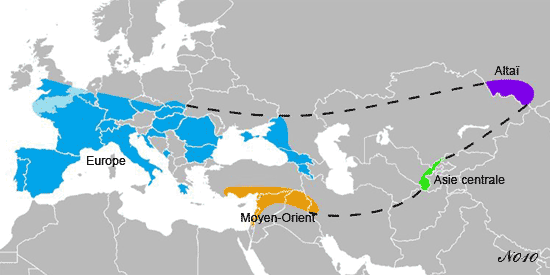
Distribution of Neanderthal man (confirmed presence):
- in Europe
- in the Middle East
- in Central Asia
- in the Altai
https://fr.wikipedia.org/wiki/Homme_de_N%C3%A9andertal#Langage_et_parole
Pre-Neanderthals were the only humans living in Europe from 300,000 years ago, at the beginning of the Middle Palaeolithic period. Pre-Neanderthals slowly evolved into the classic form of Neanderthals, whose typical characteristics were acquired from around 130,000 years ago.
https://www.inrap.fr/magazine/neandertal/Qui-es-tu-Neandertal-/J-ai-vecu-au-Paleolithique-moyen?&s=article135
Homo sapiens :
The oldest known fossils of this species, discovered in Morocco at the Djebel Irhoud site, date back approximately 300,000 years.
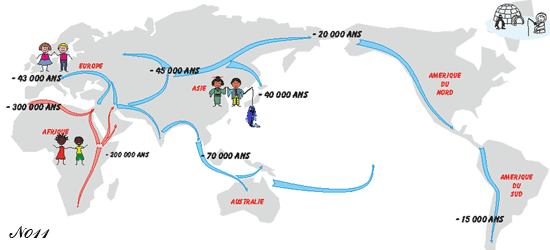
BP :
The term ‘before present’, abbreviated to BP, or sometimes "before today " (BT) is used in prehistory, palaeontology, geology and climatology to refer to ages expressed in terms of the number of years counted backwards from the present, which may be 1950, 2000 or the current year, depending on the context.
Mains négatives :
(the hand is used as a stencil onto which coloured powder is sprayed).
Self-awareness :
There are said to be five stages in the development of self-awareness and awareness of others in early life.
- First stage: sense of the body as a differentiated entity, situated and acting in the environment
- Second stage: experiences shared with others in proto-conversations constructed by adults
- Third stage: social expectations in reciprocal relationships with others
- Fourth stage: from 9 months onwards, the baby begins to show not only social expectations but also shared attention with others.
- Fifth stage: beyond 9 months and culminating at 18 months, co-consciousness, where the gaze of others is appropriated and integrated into one's own. This last stage opens the door to the development of symbolic thought.
https://shs.cairn.info/revue-enfance1-2003-1-page-39?lang=fr#s1n5
Erection during REM sleep :
Men can experience 3 to 6 erections during the night, each lasting approximately 10 to 30 minutes. These erections occur during REM sleep, with the last one occurring upon waking.
These erections result from a relaxation of the smooth muscles and vasodilation, causing blood to flow to the penis.
https://fr.wikipedia.org/wiki/Tumescence_p%C3%A9nienne_nocturne
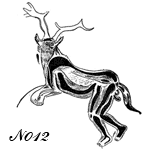
Therianthropy or zooanthropy is the transformation of a human being into an animal, either completely or partially, as well as the reverse transformation. This ancient theme has its roots in shamanism and appears in ancient drawings in prehistoric caves, such as the Trois-Frères cave in Ariège (France).
This decorated cave houses, among other things, the image of the ‘dancing shaman’ and that of the ‘little wizard with a musical bow’.
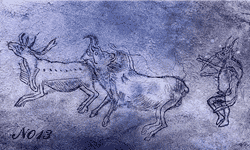
Most of the gods of ancient Egypt have the characteristic of being therianthropes.
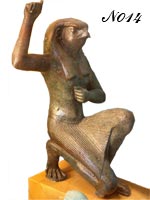
https://fr.wikipedia.org/wiki/Th%C3%A9rianthropie
4 - Human communication :
Céramics : refers to objects made from fired clay, as well as the materials and techniques associated with this process.
https://fr.wikipedia.org/wiki/C%C3%A9ramique
Coiling : The coiling technique, widely used in pottery and sculpture, involves creating a hollow form by assembling strips of clay.
https://mainsdanslaterre.com/le-modelage-de-la-sculpture-aux-colombins-en-argile-un-art-ancien-et-intemporel/

Wadi : A wadi is a watercourse that has a dry bed, except during rainfall.
In Egypt, wadis drain water towards the Red Sea.
Pictogram : a figurative drawing or graphic representation that conveys a message in a simple and recognisable way
Ligature writing : Ligature writing refers to the use of linked characters, such as ‘æ’ and ‘œ’.
The evolution of graphic representation in Mesopotamia :
Denticulates : stone tools characterised by a serrated edge.
https://fr.wikipedia.org/wiki/Denticul%C3%A9
Pidgin : a simplified lingua franca based on the vocabulary and certain structures of a base language, usually a European one.
Linguists distinguish between pidgin and creole based on the level of linguistic structure. Crucially, a pidgin becomes a creole when it becomes the native language of the population (whereas a pidgin is used only in interactions between individuals who each retain their native language).
https://fr.wikipedia.org/wiki/Pidgin
Phonogram : a written character arbitrarily representing a sound in a language, such as the letter ‘a’ for the sound [a], or a combination of letters such as ‘au’ or ‘ai’ in French.
Code of Hammurabi : a Babylonian legal text dating from around 1750 BC, to date the most comprehensive of the known legal codes from ancient Mesopotamia. It is a long royal inscription, comprising a prologue and an epilogue glorifying the ruler Hammurabi, who reigned over Babylon from around 1792 to 1750 BC. The bulk of the text consists of judicial decisions.
https://fr.wikipedia.org/wiki/Code_de_Hammurabi
Positional notation : a system that allows whole numbers to be represented and read by using the position of each digit in the text.
It is based on two principles :
- The place-value principle : each digit in a number has a value that depends on its position within the number. For example, in the number 284, the digit 4 represents the ones place, the digit 8 represents the tens place, and the digit 2 represents the hundreds place.
- The decimal principle : every number can be broken down into units, tens, hundreds, thousands, millions, billions, etc., using numerical units that are powers of 10.
https://www.alloprof.qc.ca/fr/eleves/bv/mathematiques/les-positions-et-les-valeurs-des-nombres-m1017
āšipu : an exorcist, healer and spiritual protector responsible for performing rituals to counter evil forces, using divination, incantations and sacred texts. He plays a key role in maintaining cosmic and social order.
Triplet Pythagoricien : a triplet is said to be primitive if the three integers (x), (y) and (z) are relatively prime, meaning that there is no common divisor other than 1. For example, the following triplets are examples of primitive Pythagorean triplets :
(3, 4, 5)
(5, 12, 13)
(20, 21, 29)
(11, 60, 61)
https://fr.wikipedia.org/wiki/Triplet_pythagoricien
Trigonometry : a branch of mathematics that studies the relationships between distances and angles in triangles. Its origins date back over 4,000 years, with significant contributions from ancient civilisations such as the Babylonians, Egyptians and Indians.
- Babylonians : They developed advanced mathematical concepts, including a base-60 number system, which influenced the division of the circle into 360 degrees.
- Greeks : The Greek mathematician Hipparchus of Nicaea (c. 190–120 BC) is often regarded as the father of trigonometry. He compiled the first tables of chords, relating angles to the lengths of chords in a circle. This work was continued by Ptolemy (90–168), who improved these tables and introduced trigonometric formulas.
- Indians: In the 5th century, Aryabhata introduced the concept of the sine by using the half-chord of the double angle, thereby replacing the chord tables with sine tables. Other Indian mathematicians, such as Bhaskara, also contributed to the development of trigonometric tables.
https://fr.wikipedia.org/wiki/Histoire_des_fonctions_trigonom%C3%A9triques
Boustrophedon : Boustrophedon is an ancient writing style in which lines are written alternately from left to right and then from right to left. Its name derives from the ancient Greek words for ‘ox’ and ‘to turn’, and evokes the way an ox ploughs a field, turning at each furrow.
Sensory expression : Sensory expression refers to the way in which our senses (sight, hearing, touch, taste, smell) are engaged to perceive, feel and communicate our experiences and emotions. It denotes the ability to express what we feel or perceive through sensory stimuli, whether through art, language or non-verbal behaviour.
Learning to write : Learning to write is a gradual process that takes place over several years :
- Between 2 and 3 years old : The child begins to hold a pencil and draw simple shapes such as curved lines and circles. They may start to scribble and colour in.
- Between 3 and 4 years old : Children begin to draw simple geometric shapes such as circles and squares. They may also start to trace the letters of their first name.
- Between 4 and 5 years old : Children begin to write their first name in capital letters. They learn to draw smaller, more precise shapes and to write letters and numbers.
- Around 5 years old : The child discovers cursive writing and learns to link letters and words. They can write simple words and short sentences.
- At 6 years old : The child begins to learn to write in a more formal manner.
- Between 8 and 12 years old: The child’s handwriting becomes more fluid and regular, and the letters are better connected.
https://www.pass-education.fr/age-apprendre-a-ecrire/
https://shs.cairn.info/revue-bulletin-de-psychologie-2008-5-page-449?lang=fr
Seals : Playing an important role in identifying documents and objects, they were essential tools for administration, religion and the representation of power.
The motifs depicted reflected Egyptian culture and religion.
What is art ? Art is a creative human activity that produces works or ideas intended to appeal to the senses, emotions, intuition and intellect. It is distinct from practical or utilitarian activities.
C-Ware : ceramics decorated with white hatching.
D-Ware : decorated ceramics.
From abstract language to the language of the senses :
The natural world : The natural world refers to all living beings and things existing in the universe, governed by their own laws and unaltered by human or supernatural intervention.
Insensatus : This term is the antonym of sapiens, a Latin adjective meaning ‘intelligent, wise, reasonable, prudent’.
It is formed from the privative prefix ‘in-’ and “sensatus” (derived from ‘sensus’, meaning sensation or sense).
It means: senseless, mad, irrational, unreasonable, devoid of reason.
Examples of usage:
‘Hic est insensatus, qui verba spernit sapienti.’ (Here is a fool who scorns the words of the wise.)
‘Insensata audacia eum ad perditionem duxit.’ (Foolish audacity led him to ruin.)
We shall focus on this word here to highlight the loss of sensitivity in communication, in favour of language alone.
Whilst this term, used to describe modern humans, may seem unjustified, we shall consider it necessary here in order to understand the evolution of Homo sapiens, from the time of its emergence 300,000 years ago to the present-day representative of the species [see : Narcissism and the loss of empathy].
According to our hypothesis, by acquiring a sophisticated language that enables him to transform his environment according to his desires, Homo Insensatus, unlike Neanderthals and Homo sapiens, has less need for his senses to integrate into the world.
Verbal language and vocal language : Verbal language uses words, spoken or written, whilst vocal language includes all sounds produced by the voice, including cries and intonations.
Recognition of writing :The existence of a brain area dedicated to reading had been proposed as early as the late 19th century.
In 1887, the French neurologist Joseph Jules Degerine observed lesions in the posterior part of the left temporal lobe in a patient who could no longer read but remained able to recognise objects.
This area, specialised in reading words, lies between the area that recognises faces and the area that recognises objects.
An international study led by Stanislas Dehaene of the Collège de France has confirmed that learning alters the brain’s organisation. Thus, in literate people, the language vision area is activated when reading a written word. In illiterate people, the area encoding word shapes is activated when viewing faces.
La Recherche N°449
Difference between pitch and intonation : Pitch refers to the height of the voice. We speak of a high-pitched or low-pitched voice.
Intonation refers to the inflections of the voice that create a vocal melody.
Dictionnaire Le Robert.
Reversed head nod :The head nod used to say ‘yes’ or ‘no’ is reversed in some countries compared to Western norms. In these countries, one nods from right to left to say “Yes”.
These include :
Albania,
Bulgaria,
Romania,
Turkey.
Non-verbal vocalisations : Human non-verbal vocalisations (laughter, shouts, grunts or moans) are sounds that do not form part of articulate language. They play a crucial role in social and emotional communication.
- These vocalisations are present in all cultures and at all stages of life.
- They can express emotions or physiological reactions.
- Humans can control these vocalisations to influence their communication.
Unlike learned and structured verbal communication, non-verbal vocalisations are often innate and instinctive.
Imitation and resonance in newborns :Newborns are able to imitate gestures (such as sticking out their tongue or moving their fingers) from a very early age. This ability, which can be observed from birth, is:
Selective: Newborns do not copy all gestures.
Accurate: The imitations resemble the model gestures.
Rapid: Babies react quickly after seeing the model.
Integrated: The imitations are complex and coordinated movements.
This initial form of imitation is called resonance because it is considered automatic and unconscious. Around 8–9 months, it develops into a more voluntary and controlled form.
Emotion and sensitivity : Sensitivity is the property (of a living being or an organ) of reacting appropriately to changes in the environment.
It encompasses several aspects:
- The ability to perceive physical stimuli (heat, hunger, etc.).
- The ability to experience emotions and feelings.
Emotion is an intense affective state (joy, sadness, etc.) in response to a stimulus. This state is characterised by various physical reactions (paleness, increased heart rate, etc.).
Is suffering an emotion ?
Suffering is, above all, a subjective experience that can manifest itself on various levels: physical, emotional…
On a physical level, by acting as a warning signal, it can be seen as a mechanism for protection and adaptation to our environment.
Emotionally, it can be triggered by events such as the loss of a loved one, betrayal, a lie…
Neurophysiological studies have shown that physical pain and emotional suffering follow similar pathways in the brain.
Homo neanderthalensis : Neanderthal man is an extinct species of the genus Homo, which lived in Europe, the Middle East and Central Asia until around 40,000 years ago. According to a genetic study published in 2016, it shares a common ancestor with Denisovans dating back approximately 450,000 years. This ancestor itself shares a common ancestor with Homo sapiens dating back approximately 660,000 years.
Advances in prehistoric archaeology have revealed a human species with a certain level of cultural development. It mastered various advanced techniques such as birch-pitch bonding, and certain fossil remains dating back less than 70,000 years are considered to be burials indicating funeral rites.
https://fr.wikipedia.org/wiki/Homme_de_N%C3%A9andertal